

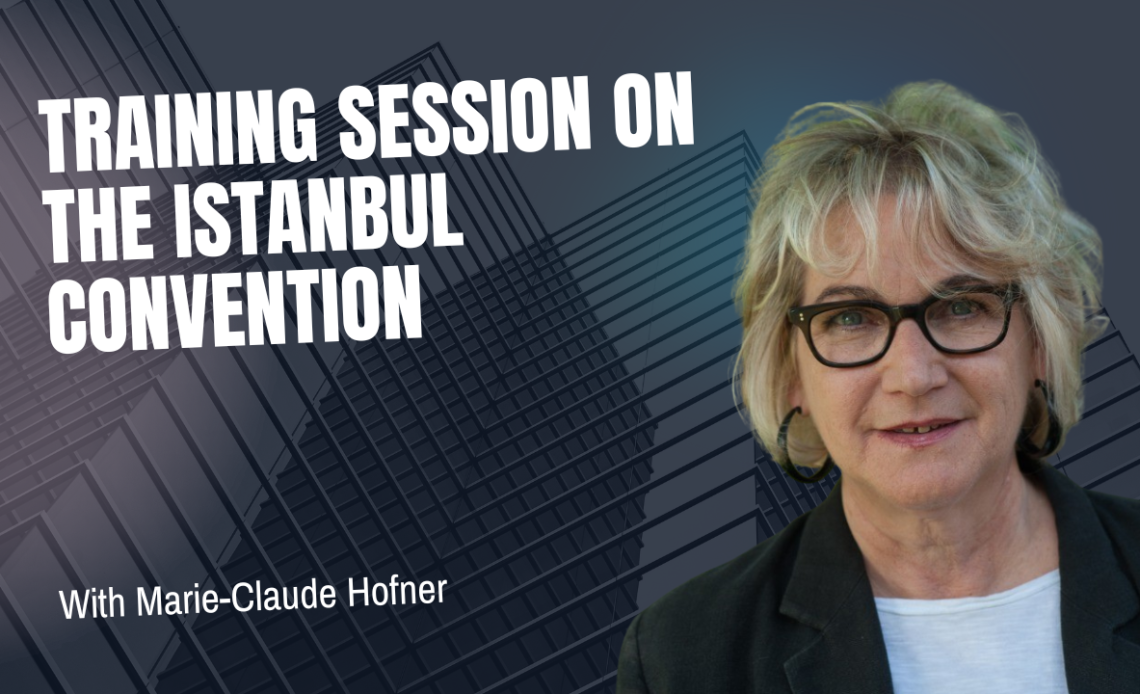
Training Session on the Istanbul Convention and the Work of GREVIO
On 3 October 2025, ASSEDEL had the pleasure of hosting Dr. Marie-Claude Hofner, medical doctor and member of the Group of Experts on Action against Violence against Women and Domestic Violence (GREVIO) — the independent monitoring body of the Council of Europe Convention on Preventing and Combating Violence against Women and Domestic Violence, widely known as the Istanbul Convention.
The session provided a unique opportunity for ASSEDEL’s team to explore, in depth, the functioning of GREVIO and the broader context of the Istanbul Convention — a pioneering international treaty that remains the gold standard for the protection of women and girls from violence.
Violence Against Women: A Persistent and Complex Reality
Dr. Hofner began by recalling that violence against women remains one of the most widespread and persistent human rights violations in Europe and beyond. She illustrated the complexity of this phenomenon with the image of an iceberg: the visible tip represents the most extreme and public forms of violence — such as physical assaults or femicides — while the much larger invisible part represents the countless hidden forms of violence: psychological manipulation, verbal abuse, economic control, and even daily sexist remarks.
This analogy serves as a reminder that the fight against violence must go far beyond addressing only the visible symptoms — it must tackle the underlying structural and cultural roots of gender inequality.
From Private Matter to Public Concern
Dr. Hofner emphasised that violence against women should not be considered a private or individual problem, but rather a public issue requiring collective responsibility and state action.
For a social phenomenon to be recognized as a public issue, it must meet several criteria: it must be frequent, have serious health consequences, negatively affect society as a whole, and be preventable. All these conditions apply to gender-based violence.
• Frequency: Studies show that nearly one in three women (30.7%) in the European Union experiences physical or sexual violence, or threats, during her lifetime.
• Health impact: The impact on both physical and mental health is grave. Victims are far more likely to suffer from depression, suicidal thoughts, addiction, and chronic health conditions such as cardiovascular diseases.
• Social consequences: Around 70% of children in households where violence occurs are directly exposed to it, and 40–60% of perpetrators were themselves victims during childhood — perpetuating a vicious cycle of violence.
• Prevention: Because violence is a learned behavior, it can also be unlearned. Measures such as early detection of victims, education of children and young people, awareness-raising, and protection of victims should be implemented. All these prevention measures have been evaluated and assessed, showing that they work.
Dr. Hofner stressed that gender-based violence has far-reaching effects that go beyond the individual level — it affects families, communities, and entire societies. Its economic impact is also considerable, generating enormous costs for healthcare systems and lost productivity.
The Istanbul Convention: The Gold Standard of Protection
Adopted by the Council of Europe in 2011 and entering into force in 2014, the Convention is open not only to the 46 member states of the Council of Europe (all except Azerbaijan have signed it), but also to non-European countries, showing its universal value.
It protects all women — including those belonging to vulnerable groups such as migrants, refugees, or women with disabilities — and recognizes that violence against women is both a form of discrimination and a violation of human rights.
The Istanbul Convention is built around the ‘4Ps’, a comprehensive approach that integrates multiple dimensions of action:
Prevention — States must address the root causes of violence by promoting gender equality, deconstructing gender roles, and organizing awareness and educational campaigns.
Protection — The strategy focuses on the role of the state in protecting women from violence and creating a safe environment.
Prosecution — The focus should lie on establishing legislation, good investigations, and systematic risk assessments, to fight violence against women. In particular, it is imperative to ensure that perpetrators are held accountable for their actions.
Integrated Policies — States must coordinate policies across all sectors — justice, health, education, and law enforcement — to ensure a coherent and efficient response.
GREVIO: Monitoring the Implementation of the Convention
The Group of Experts on Action against Violence against Women and Domestic Violence (GREVIO) is responsible for monitoring the implementation of the Istanbul Convention in each state party. It is composed of 15 independent experts elected for their competence and integrity. GREVIO’s work is based on two main mechanisms:
Country evaluation reports, which assess how states are implementing the Convention’s provisions in law and in practice based on detailed questionnaires to governments; through country visits, and information delivered by NGOs.
Thematic evaluations and recommendations, aimed at strengthening public policies and improving coordination among institutions.
A Global and Collective Responsibility
Dr. Hofner reminded participants that the fight against violence is not only the responsibility of women — men and boys must also be part of the solution. Changing mentalities, challenging gender stereotypes, and promoting respectful relationships require the participation of everyone in society.
She concluded by underlining the importance of education and early awareness, both for children and adults, as a means to prevent violence before it occurs. Addressing the roots of inequality and ensuring consistent, long-term political commitment remain essential for lasting change.
The exchange with Dr. Hofner enriched the understanding of the ASSEDEL team on the mechanisms of the Istanbul Convention and on the practical challenges faced by GREVIO in its mission to ensure the effective implementation of women’s rights across Europe.
ASSEDEL warmly thanks Dr. Marie-Claude Hofner for her availability and for sharing her expertise, which greatly contributed to strengthening the knowledge and motivation of its young team in Strasbourg.