

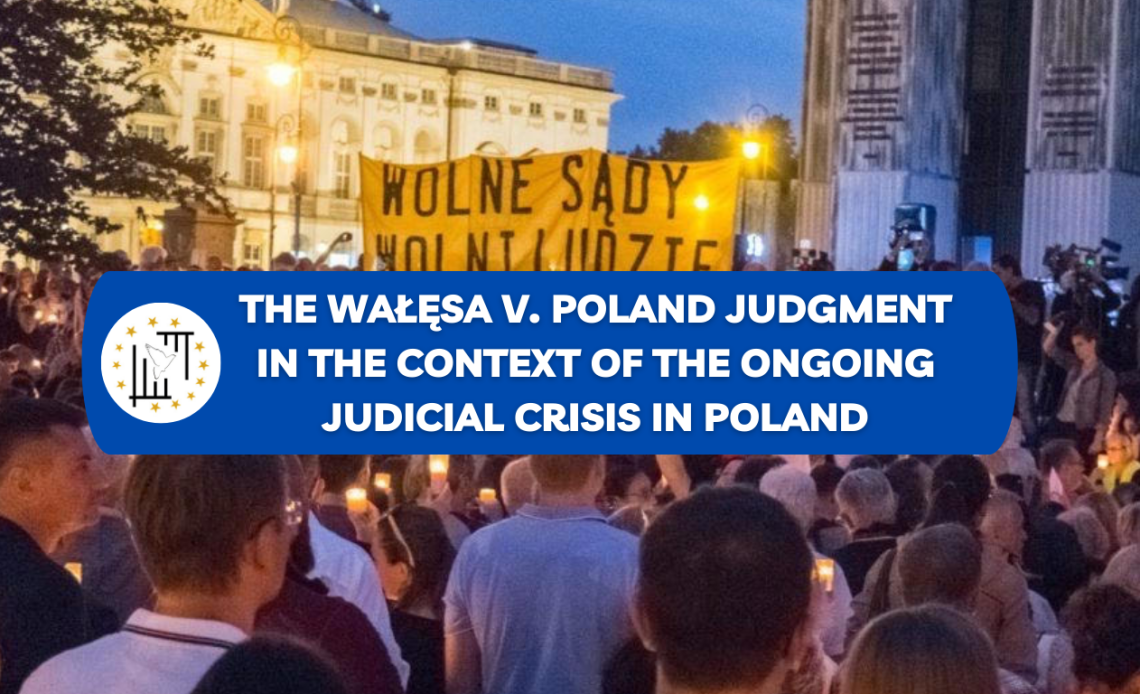
Observations of ASSEDEL on the ongoing work of the Venice Commission
ASSEDEL prepared a report contributing to the ongoing assessment conducted by the Venice Commission within the framework of its Joint Opinion No. 238/2025 on the draft law concerning the status of judges appointed or promoted between 2018 and 2025 and other related matters, prepared jointly with the Directorate General of Human Rights and Rule of Law of the Council of Europe. The report aims to provide a comprehensive legal and factual assessment of the current judicial crisis in Poland and to support European institutions in evaluating the compatibility of the proposed reforms with European rule of law standards.
Judicial Reforms Under Scrutiny
Since 2015, Poland has undergone far-reaching reforms of its judicial system following the electoral victory of the Law and Justice party (PiS). These changes have profoundly altered the structure and functioning of key judicial institutions, sparking widespread concern at both the domestic and international level. International bodies, including the European Commission and the Council of Europe, have repeatedly warned that the reforms undermine the rule of law and weaken judicial independence.
Politicisation of the National Council of the Judiciary
One of the most controversial reforms concerned the National Council of the Judiciary (KRS), the body responsible for safeguarding judicial independence and recommending judicial appointments. Since 2018, fifteen judicial members of the KRS have been elected by the Sejm, rather than by judges themselves. This shift significantly increased political influence over judicial appointments and led to the emergence of the so-called “neo-KRS,” whose legitimacy has been widely questioned by courts, scholars, and international institutions.
The Rise of Neo-Judges and Its Consequences
As a result of appointments made through the politicised KRS, a growing number of so-called “neo-judges” now sit in Polish courts. According to the Ministry of Justice, they constitute approximately 28% of judges in ordinary courts, 34% in the Supreme Administrative Court, and as many as 60% in the Supreme Court. Their participation in adjudication has already resulted in over 5.5 million złoty in compensation awarded by the European Court of Human Rights (ECtHR) for violations of the right to a fair trial.
Extraordinary Appeal and Legal Uncertainty
Another key reform was the introduction, in 2017, of the extraordinary appeal as a mechanism allowing final court judgments to be reopened. Jurisdiction over these cases was granted exclusively to the newly created Chamber of Extraordinary Review and Public Affairs (CERPA). However, this chamber itself has been composed entirely of judges appointed with the involvement of the neo-KRS, raising serious doubts as to its independence and legality. The extraordinary appeal procedure has been heavily criticised for violating legal certainty and enabling political interference in final judgments.
The Wałęsa v. Poland Judgment
These systemic problems culminated in the landmark judgment of Wałęsa v. Poland, in which the ECtHR held that the extraordinary appeal of Lech Wałęsa’s long-final civil judgment violated Article 6 of the European Convention on Human Rights. The Court found that CERPA was not an independent and impartial tribunal established by law and that the extraordinary review mechanism was used as a political instrument to overturn an unfavourable judgment. This case became a symbolic example of how judicial reforms have affected individual rights.
Pilot Judgment and Systemic Crisis
What distinguishes the Wałęsa judgment from earlier cases is that the Court decided to apply the pilot-judgment procedure. It identified deep, interrelated structural problems at the heart of the Polish judiciary: the defective composition of the KRS, the lack of independence of CERPA, and the misuse of the extraordinary appeal procedure. The Court noted the rapidly increasing number of similar applications and concluded that these issues amount to a systemic threat to the rule of law in Poland.
Attempts at Legislative Repair
Recognising the scale of the crisis, the Ministry of Justice has prepared a draft act aimed at restoring the right to an independent and impartial court and regulating the legal effects of resolutions adopted by the neo-KRS between 2018 and 2025. The bill also seeks to implement the Wałęsa judgment. However, the proposal has met with criticism, including from the Polish Ombudsman, who warn against automatic invalidation of judicial appointments without individual judicial review.
To read full report, please click here.