

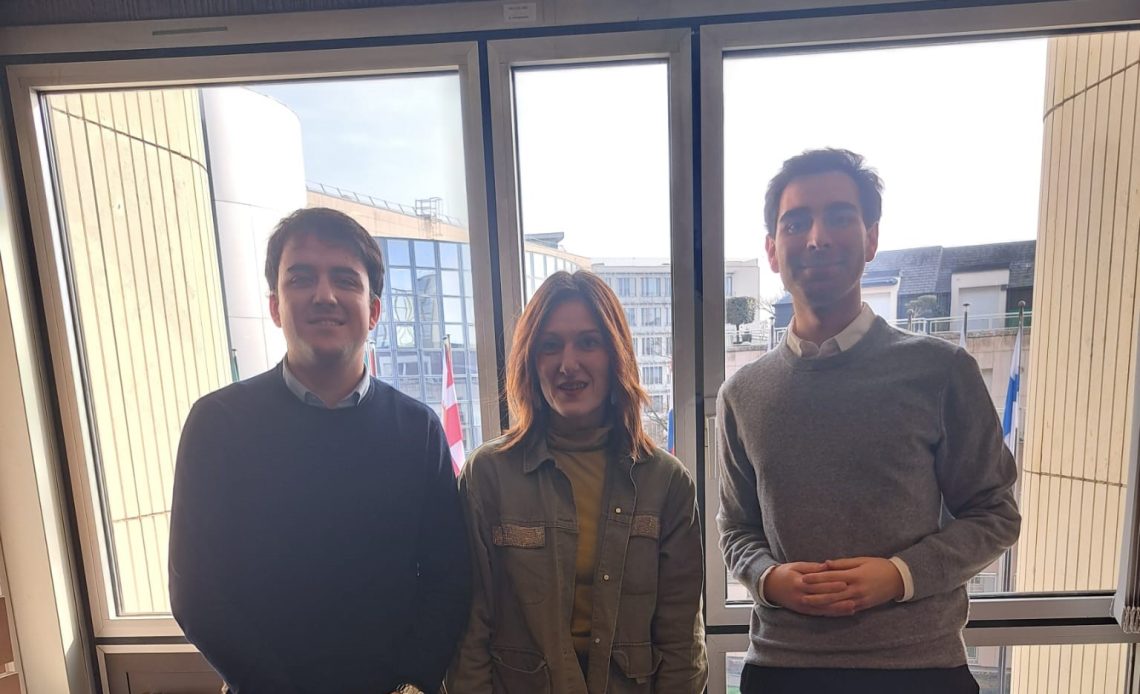
At the latest plenary sessions in Strasbourg, ASSEDEL interviewed Oihane Agirregoitia, Member of the European Parliament (MEP) from the Renew Europe group. An industrial engineer by training, with a strong background in innovation and organizational development, she currently serves as Vice-Chair of the Delegation for relations with Mercosur.
In this interview, she reflects on the political and economic implications of the EU- Mercosur trade agreement —the largest free trade area project in the world— and outlines the European Parliament’s role in ensuring that trade expansion does not undermine environmental standards, labour rights, or the viability of the European primary sector.
The Interconnection of Industry, Energy and Trade
Agirregoitia emphasizes that in the current geopolitical landscape, no policy exists in a vacuum. Her work as member of the Committees of Transport and Turism (TRAN) and Industry, Research, and Energy (ITRE) is directly linked to her leadership in the Mercosur delegation. For her, trade agreements are not just about exchange, but about strategic connectivity.
“Everything is related. If we want to gain industrial muscle and competitiveness against giants like China and the United States, connectivity is strategic. You are either connected, or you are out of the game,” she explains. For regions with a strong industrial fabric, such as the Basque Country, the Mercosur agreement represents a gateway for the automotive and industrial sectors to markets with which there are deep historical and cultural ties.
Addressing the Crisis in the Primary Sector: Policy vs. Blockage
One of the most sensitive points of our conversation was the response to the recent agricultural protests that have mobilized tractors across Europe. The MEP acknowledges that the fears of the primary sector are legitimate, as it is a sector that is currently suffering, but she argues that blocking the agreement might not be the right solution.
“Fears are legitimate and the primary sector is suffering, but perhaps the solution is not Mercosur, or at least not only Mercosur”, reflects. She points out that issues such as generational renewal and production sustainability are structural problems that should be addressed through the Common Agricultural Policy (CAP) and modernization, rather than through commercial isolation.
Regarding the specific controversy over beef and hormones, Agirregoitia is categorical: “There has been much concern about the beef sector and hormones. Those hormones are prohibited in the EU. What we must do is not block the agreement, but ensure and guarantee that these products do not enter our market through reinforced controls.”
Unprecedented Safeguards and Human Rights
In response to criticism from NGOs regarding the respect for human rights in supply chains in third countries, the MEP defends the Mercosur agreement as a pioneer in protection mechanisms.
“I honestly believe that the concerns raised have led to the incorporation of safeguard mechanisms that other trade agreements do not have. I wish other agreements carried the same defense tools as Mercosur,” she states. Agirregoitia highlights that the agreement includes binding commitments to the Paris Climate Agreement and strict compliance with international labor and phytosanitary regulations, backed by a commitment to increase border controls by 50%.
The “Judicial Blockage” and Cultural Synergy
The agreement, which has been under negotiation for over 25 years, currently faces a new hurdle: the European Parliament’s decision to seek an opinion from the European Court of Justice to verify if the procedure complies with the treaties. Mrs. Agirregoitia views this move with skepticism, suggesting it may be a tactic to delay what she considers inevitable.
“We are constantly asking the European Commission for agility because the EU is slow compared to China or the US, and then we decide to prolong this by 12 or 18 months or even more through these procedures,” she points out.
Finally, she highlights a factor often overlooked: cultural affinity. She notes that for many European companies, like the ones from Basque Country, it is far more natural to cooperate with Brazil or Argentina than with other emerging powers like India, due to the lack of language barriers and the presence of the diaspora. “That cultural hook is a strategic advantage that we should not waste”.
ASSEDEL, based in Strasbourg and committed to the promotion of human rights and European values, continues to follow and shed light on developments that shape the future of European democracy and international relations.