

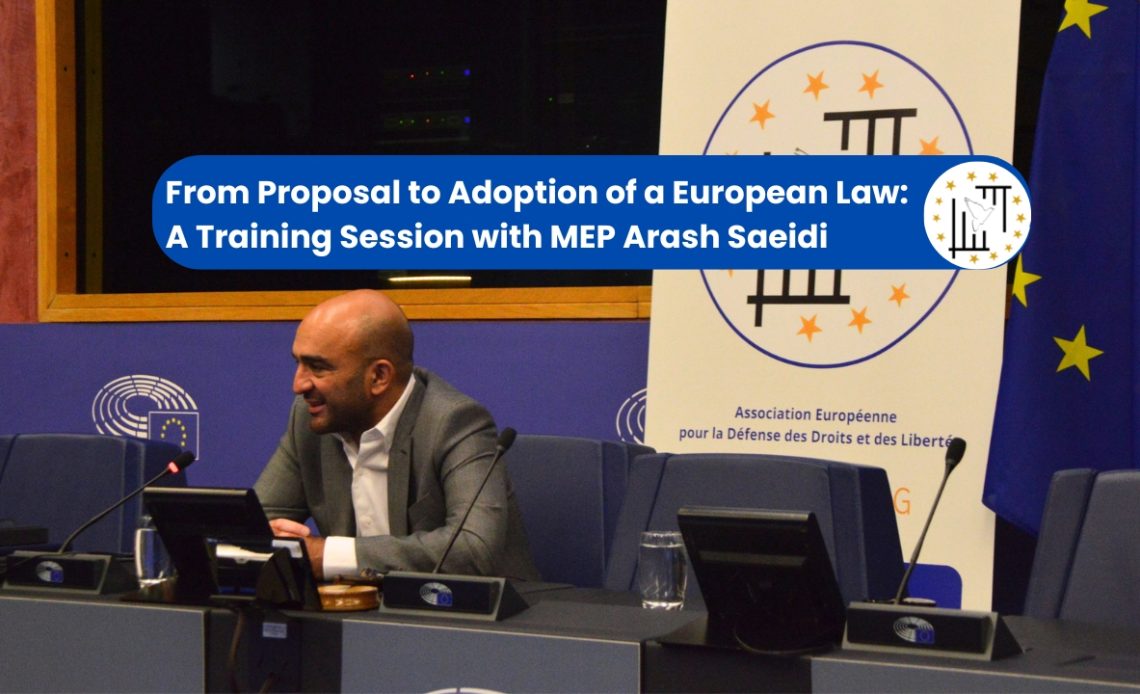
From Proposal to Adoption of a European Law: The Process Simplified.
ASSEDEL had the opportunity to participate in a training session led by Arash Saeidi, Member of the European Parliament and of the group The Left. He is a member of several committees, including the Committee on Transport and Tourism and the Committee on Agriculture and Rural Development, as well as a member of the delegation to the Parliamentary Stabilization and Association Committee between the European Union and Montenegro, and a jurist by schooling.
Thanks to his political commitment, which spans from the early 2000s to the present, he served as a city councilor for Angers and as a community councilor for Angers Loire Métropole from 2020 to 2024. He was elected regional councilor in 2021 and then Member of the European Parliament on June 9, 2024.
The Culture of the European Parliament: Behind the Passage of Laws
To illustrate the practice of parliamentary debate in Strasbourg, a telling image was offered: that of a person speaking passionately in a language the other MEP does not know, while the other Member of the European Parliament, wearing headphones, tries to follow the speech through a calm and assertive French interpretation.
This phenomenon creates a gradual lag in content, but also gives rise to a distinctive atmosphere and rhythm in parliamentary exchanges. The translation provided by the interpreters can sometimes be slow, creating a delay that can extend up to about fifteen seconds.
Furthermore, when certain speeches are delivered in languages that are less widely spoken, they are first translated into English before being relayed into French by the interpreters. The loss of detail that occurs when translating from one translation to another is evident.
The tone also changes, resulting in a calmer pace than in other institutions—the National Assembly, for example, features less measured discussions. According to Saeidi, a person’s native language allows them to present arguments with greater subtlety than when speaking another language.
Another key point was highlighted: the culture of compromise. The difficulty of securing a majority leads all political groups, even the largest ones, to prioritize negotiation
The difficulty of securing a majority leads all political groups—even the largest ones—to prioritize negotiation and mutual understanding among stakeholders.
In this regard, it was emphasized that the unique cultural context of each group plays a decisive role. Mutual understanding of identities, traditions, and political sensibilities appears to be an essential prerequisite. Indeed, getting to know one another is often the only sustainable path toward genuine political collaboration.
Furthermore, the development of discussion processes in a setting such as Strasbourg is a key feature that we will explore in greater depth in the final section of this article.
The Legislative Process
The legislative proposal is drafted by the European Commission, which submits it simultaneously to the European Parliament and the Council of the European Union. Within the European Parliament, the proposal is assigned to the relevant parliamentary committee, which is responsible for reviewing it.
Within this committee, a rapporteur is appointed to lead the work on the text. The various political groups also appoint shadow rapporteurs, who monitor the dossier and participate in negotiations. The rapporteur, the shadow rapporteurs, and the committee members work to formulate the Parliament’s position by proposing and reviewing amendments.
In parallel with the political work of the Members of the European Parliament, technical work is carried out by advisors, sector experts, legal experts, and parliamentary assistants. These individuals help translate political guidelines into concrete and legally sound proposals. Through numerous rounds of consultation, they ensure consistency between the political objectives being pursued and their concrete implementation in the legislative text.
Within a Member of the European Parliament’s office, Accredited Parliamentary Assistants (APAs) play a key role in preparing for parliamentary work. They analyze amendments, prepare voting positions, and submit their recommendations to the Member, who retains responsibility for the final political decision.
After negotiations and a vote on the amendments in the parliamentary committee, a report is adopted and forwarded to the European Parliament’s plenary session. There, MEPs debate the text, defend their positions, and vote on the Parliament’s position at first reading.
At the same time, the Council of the European Union also examines the Commission’s proposal with the support of its technical working groups and representatives of the Member States. Exchanges and negotiations may then take place between the Parliament, the Council, and the Commission, particularly during trilogues, to reach a common text. This back-and-forth process allows the text to be refined and, if necessary, amended further before its final adoption.
When asked about the typical duration of the process, Arash Saeidi cited the 2013–2014 reform proposal for Regulation (EC) No. 261/2004 as an example. This reform of air passenger rights required three years of revisions within the Commission before being adopted by the Parliament in less than a year. However, the divergent interests of member states have slowed the process in the Council for about a decade.
He also mentioned the Corporate Sustainability Due Diligence Directive (CSDDD), a European regulation aimed at holding large international companies accountable for their environmental impact, which took three years to be adopted. In the best-case scenario, the most effective laws can be adopted within 6 to 12 months.
Strasbourg: Symbol and Limits of European Compromise
However, the practical functioning of European institutions reveals certain limits to this ideal of neutrality and compromise. On the one hand, the Council of the European Union has the real power to block or slow down the legislative process, which can undermine the momentum for adopting legislation. On the other hand, even within the Parliament itself, the logic of negotiation among majority political groups can sometimes stray from a genuine culture of compromise. In some cases, these groups draft parallel texts or alternative proposals, creating a form of implicit pressure on other actors: accept a pre-established compromise or risk having a version imposed on them that is even further removed from their political preferences. Thus, negotiation can take the form of a structured power struggle, where compromise becomes less a process of convergence than a strategic instrument of political domination.
A region historically marked by conflicts and territorial realignments, it has today become one of the strongest symbols of Franco-German reconciliation and, more broadly, of European cooperation. Along with Brussels, it constitutes one of the political capitals of the European Union, embodying a shared institutional space where member states come together outside their usual national frameworks. Ultimately, Strasbourg strongly embodies the European ideal of reconciliation and political cooperation as a shared institutional space where member states are expected to transcend their national interests to reach a constructive compromise.