

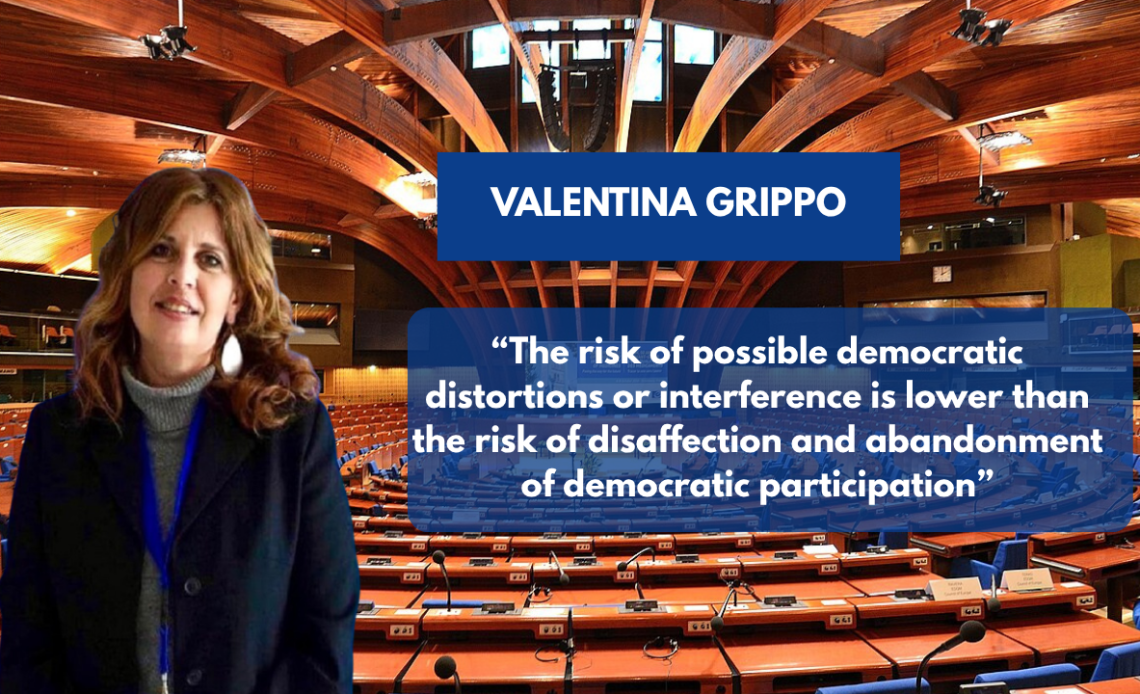
During the PACE session of April in Strasbourg, ASSEDEL contacted multiples members and exponents with the aim to focus on the New Democratic Pact on which it is preparing several works and reports.
Regarding this article, Italian MP Valentina Grippo agreed to participate by answering some concerns that are affecting the new democratic initiative mentioned above. Mrs Grippo, in the current Italian legislature, is Vice-President of the Committee on Culture, Science and Education and she is member of the delegation to the Parliamentary Assembly of the Councilof Europe in representation of the group of Alliance of Liberals and Democrats for Europe (ALDE).
The interviews focused on the New Democratic Pact and the main topics that revolve around it such as the necessity of a battle for social justice, growing wave of youth participation and the control platform judgment methods.
The current global context highlights a significant decline in the quality and diffusion of democratic institutions. Grippo tells us that according to what emerged in the debate on the New Democratic Pact, the percentage of the world’s population living in fully democratic systems would have increased from 45% to 25%. This figure is not only a quantitative indicator but signals a structural change: democracy can no longer be considered a stable prerequisite, but rather a balance to be built and defended.
Democracy and social justice: an inseparable link
One of the central points that emerged concerns the impossibility of separating the defence of democracy from the promotion of social justice. The stability of democratic systems, in fact, depends on the ability to guarantee rights, equity and access to opportunities. Grippo emphasizes how a democracy lacking social justice is inherently fragile: inequality undermines trust in institutions and undermines effective citizen participation. In this respect, the protection of human rights and the reduction of disparities are necessary conditions for democratic stability.
Crisis of trust and institutional transformation
Digital transformation and the simplification of democratic concept have contributed to a
growing distrust of institutions, such mistrust is also fuelled by a widespread perception of
representative inadequacy.
According to Grippo, institutions must evolve on multiple levels such as becoming faster and more responsive in decision-making processes, adopting a pragmatic results-oriented approach and reducing bureaucratic complexity.
In parallel, action must be taken on the mechanisms of control, selection and transparency to rebuild credibility and legitimacy. Institutional modernization is therefore not just a technical issue, but a condition for re-establishing the relationship of trust between citizens and governance.
New generations and civic participation
An element of positive discontinuity is represented by the growing involvement of the new generations. Recent mobilizations on global issues, from international conflicts to environmental and social issues, testify to a strong demand for participation.
This phenomenon highlights a paradox: faced with institutions perceived as distant, a civil society -particularly youth- emerges that is increasingly active and eager to make an impact. Grippo interprets this dynamic as a strategic opportunity: strengthening channels of participation can help regenerate the democratic system.
Voting Access and Democratic Inclusion
Among the operational proposals, the issue of accessibility to voting stands out strongly. In particular, facilitate voting for out-of-towners, consider extending voting to sixteen-year-olds and promote digital voting solutions; with the aim to make the democratic process more inclusive and tangible.
In this context, Grippo states: “The risk of possible democratic distortions or interference is lower than the risk of disaffection and abandonment of democratic participation”.
Political Paths and Civic Engagement
On the topic of political education, the importance of gradual and structured paths is emphasized. Local government levels represent, according to Grippo, a fundamental space for concretely understanding administrative processes and developing skills.
At the same time, civic engagement is not limited to institutions: there are multiple forms of participation -from cultural production to writing- that contribute to the construction of the “polis” understood as an active community.
Culture as a democratic infrastructure
Another strategic axis is represented by culture, defined as a precondition of democracy. A citizen who can understand, analyse and interpret reality is in fact better able to exercise hisor her rights.
Grippo highlights a significant contradiction: although the cultural sector represents approximately 7% of GDP in countries like Italy and France -more than the automotive and agricultural sector- cultural policies are often reduced to entertainment policies.
Digital platforms and content governance
The role of digital platforms represents one of the most complex challenges. On the one hand, there is a growing demand for intervention to combat phenomena such as hate speech, rights violations and risks to minors. On the other hand, the attribution of supervisory powers raises questions about the transparency and impartiality of the criteria adopted.
Grippo illustrates the need for balance in combining automated systems and human supervision, in defining shared standards and clear criteria ensuring training and neutrality of those involved in moderation. The global size of the platforms also makes it difficult to adopt uniform parameters, due to cultural differences in value and judgment systems.
European dimension and supranational cooperation
Within the framework of the new democratic pact, the centrality of the European dimension emerges strongly. She points out the need to strengthen the role of supranational institutions, such as the Council of Europe and the European Union, by protecting them from national political exploitation.
The construction of effective European governance requires an approach that overcomes the logic of deployment, privileging a common vision oriented towards the protection of democratic values.
In conclusion, a cross-cutting priority clearly emerges which is education. Our host stressed how access to education is the basis for conscious and informed democratic participation, investing in schools means reducing inequalities and promoting active citizenship.
Additionally, the proposed analysis shows how the crisis of democracy cannot be traced back to a single factor, but to a set of interconnected transformations: social, technological, cultural, and institutional. In this scenario, the main challenge is to transform current critical issues into opportunities for renewal, building more resilient, inclusive, and adaptive democratic models.
You can watch the full interview on our YouTube channel.