

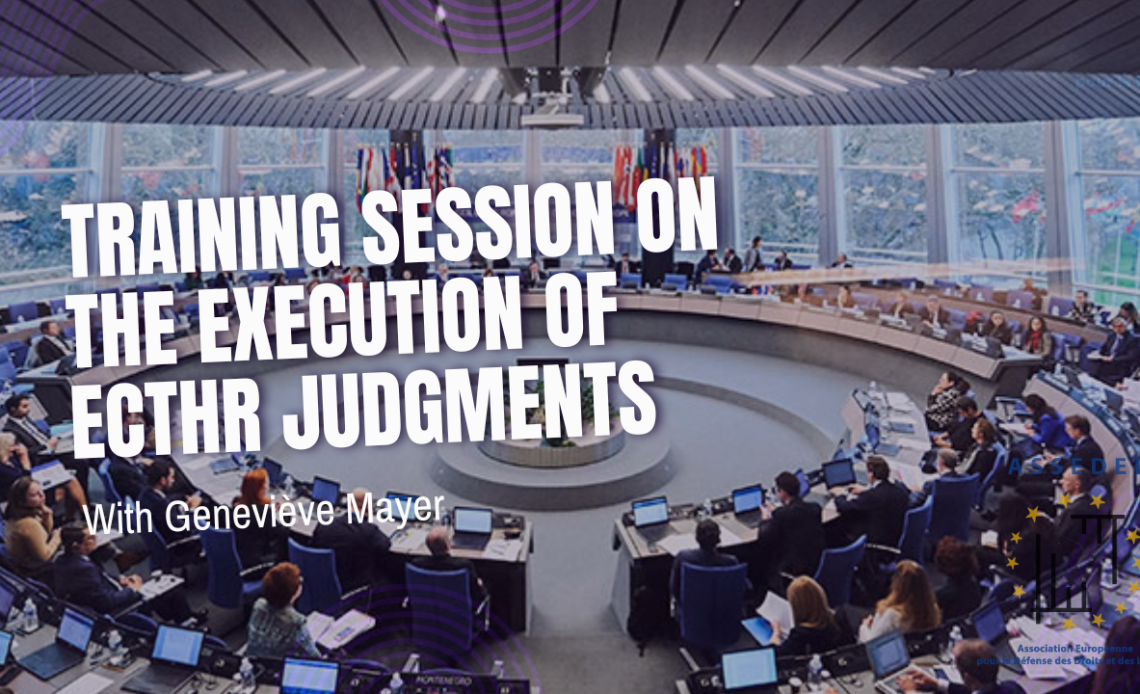
How do judgments of the European Court of Human Rights (ECtHR) move from paper to real change on the ground after a finding of a violation by the Court ? This question was at the heart of a training session led by Geneviève Mayer, former Head of the Department for the Execution of ECtHR Judgments at the Council of Europe.
A cornerstone for the efficiency of the Convention system is the acceptance of the authority of the Court’s judgments and decisions. This depends very much on the post-judgment procedure set up to ensure that respondent States abide by their unconditional obligation under Article 46 of the European Convention on Human Rights to execute the final judgements rendered against them.
Under the same Article 46, the supervision of the execution of the European Court of Human Rights final judgements and decisions is entrusted to the Committee of Ministers of the Council of Europe. The Committee of Ministers is the executive body of the Council of Europe, composed of the representatives of the 46 Member States . This means that, all Council of Europe member States share the collective responsibility to ensure that respondent States fully execute the judgments and decisions of the European Court of Human Rights rendered against them, and through this, share a collective responsibility to ensure the common understanding and effective observance of the Convention.
How does the supervision process operate?
The practice developed by the Committee of Ministers over the years is reflected in Rule 6 of its Rules for the Supervision of the Execution of Judgments and of the Terms of Friendly Settlements.
There are three main requirements for a respondent State to execute a judgment of the European Court of Human Rights, namely:
- Payment of any just satisfaction awarded by the Court;
- Adoption of individual measures to prevent the continuation of the violation(s) for the applicant and to erase the consequences of the violations still suffered;
- If necessary, adoption of general measures addressing the roots of the violation(s) found in order to prevent similar violations to occur.
The supervision process means first of all looking at the judgment of the European Court of Human Rights with a fresh eye, placing it in the post-violation context. Fundamental questions at this stage include: What is the current situation of the applicant? What are the roots of the violation(s)? Is it an isolated case or does it reveal a more complex or systemic problem? Are there other similar cases already under the Committee of Ministers’ supervision? Have measures already been taken by the respondent state? Are they adequate and sufficient or not?
In line with the principle of subsidiarity, it is primarily the responsibility of respondent States to present their views on these issues and on how they intend to implement the judgment concerned. They are asked to present an action plan with time tables as soon as possible and not later than 6 months after the judgment becomes final.
Respondent States enjoy a wide margin of appreciation in choosing the measures to be adopted and the possible timetables for reforms, provided that those measures are:
- Compatible with the conclusions of the Court and its case-law in the area concerned and the Committee of Ministers’ practice as to what effective execution requires;
- Capable of providing adequate redress and prevention.
When a respondent State considers that it has taken all the necessary measures to implement the judgment, it presents an action report to the Committee of Ministers . The Committee will then decide whether the measures taken enables it to close its supervision of the case.
The European Court of Human Rights may identify general measures in its judgments to address structural problems—through a pilot judgment or a so-called Article 46 judgment—in order to assist respondent States and the Committee of Ministers in the post-judgment phase.
In addition, the European Court of Human Rights may consider it opportune to give in a judgment under Article 46 an indication in respect of an individual measure, generally when the violation found leaves no choice as to the measure required. It nevertheless remains for the Committee of Ministers to ensure the implementation of such a measure, in light of the circumstances as developed at the time of the supervision of the given judgment.
There is an impressive record of individual and general measures taken by respondent states under the Committee of Ministers’ supervision. Many illustrations of such measures —often implying vast reforms—can be found in the thematic and country factsheets published on the Department for the Execution of Judgments of the ECtHR website and in the Committee of Ministers annual reports on its supervision of the execution of judgments and decisions of the ECtHR.
A central role in this system is played by the Department for the Execution of Judgments, which can be described as the “driving engine” of the supervision process. The Department assists the Committee of Ministers with its independent and impartial analyses and expertise, and by making proposals to the Committee for the prioritisation of cases, as well as proposals for decisions, interim resolutions; for further action to be taken, or for closure of cases. It also supports respondent States through legal and technical assistance on the identification and implementation of measures needed to achieve full and effective implementation. This includes on-the-spot missions to meet key national actors, including the involvement of other relevant Council of Europe bodies.
The Department is also a key partner for the civil society which plays a significant role in this supervision process.
Civil society and rule 9 submissions
An important aspect of the supervision process by the Committee of Ministers is the possibility for third-party input under Rule 9 of the Committee of Ministers’ Rules for the supervision of the execution of judgments and of the terms of friendly settlements. Civil society organisations, national human rights institutions, judges’ associations, bar associations, bodies intervening before the European Court of Human Rights, and international intergovernmental organisations are entitled to submit information and their views on the implementation of judgements by respondent states to the Committee of Ministers. Such submissions are of utmost importance to both the Committee of Ministers and the Department in the assessment of the post-phase judgment. It is therefore crucial that the supervision process can continue to count on the contribution of civil society and of all those entitled to make submissions to the Committee of Ministers.
What are the Committee of Ministers tools ?
The supervision role of the Committee of Ministers occupies a specific place in its work. The Committee devotes specific meetings to this role—known as Human Rights meetings—specifically for this purpose. These meetings also provide an opportunity for a direct dialogue with high-level actors of respondent States on the progress of difficulties in the domestic execution process.
Over the years, the Committee developed a graduated tool box combining constructive dialogue -which is a central piece of the exercise-, peer pressure, and support to respondent states via cooperation programs, expertise, and exchange of experiences. When necessary, the Committee of Ministers uses political leverage to ensure that respondent States draw all necessary consequences of the findings of the European Court of Human Rights judgments in good faith.
With the entry into force of Protocol No. 14 to the European Convention on Human Rights, two additional tools were introduced under Article 46 of the Convention to ensure respondent states’ compliance with the judgments of the European Court.
The first additional tool, foreseen in Article 46 §3, enables the Committee in case it considers that the supervision of the execution of a final judgment is blocked by a problem of interpretation of the judgment to refer the problem to the Court. So far, the Committee did not make recourse to this tool yet.
The second tool, foreseen in Article 46§ 4, is the so-called infringement procedure. If the Committee of Ministers considers that a respondent state refuses to abide by a final judgment of the European Court of Human Rights, it can refer the question to the Court. The Committee of Ministers had twice recourse to this procedure. The first time was in the case of Ilgar Mammadov v. Azerbaijan. The aim of the procedure was achieved as the applicant’ convictions were quashed by the domestic courts; he was released and received compensation for his unlawful arrest and detention.
The second time the procedure was used was in the case of Osman Kavala v. Türkiye. Despite a judgment of the European Court of 10 December 2019 (final on 11 May 2020) that asked to put an end to his detention and to secure his immediate release, as well as the repeated calls from the Committee of Ministers for his release, the applicant remained in detention. The Committee referred the matter to the Court under the Article 46 §4 procedure. The Grand Chamber delivered its Article 46§4 judgment on 11 July 2022 concluding that the respondent State has failed to fulfill its obligation under Article 46 § 1 of the Convention. The situation of Osman Kavala remains under very close supervision of the Committee of Ministers. The most recent decision adopted by the Committee illustrates once again the efforts deployed to ensure the respondent State’s compliance with its obligation under the Convention and its strong insistence that the authorities now take concrete steps to move towards the applicant’s release.
What are the challenges for the supervision process?
An important test for the democratic security is the level of implementation of the Strasbourg Court’s judgments and the respect of the Convention system.
It is reassuring to see from the Committee of Ministers’ latest annual report that many positive developments in the implementation of the European Court of Human Rights judgements have continued to be registered in 2024. However, this report also highlights quite a number of challenges to be faced by the system, with an increased number of pending cases under the supervision of the Committee of Ministers often raising complex issues and /or systemic problems.
These different challenges show the importance of sustained political will and determination to implement the Court’s judgments. They also show the need for strong domestic capacities to ensure efficient and speed measures at national level. The creation in 2024 of the network of national coordinators for the execution of the European Court of Human Rights judgments can be a key tool to enhance such domestic capacities. They further highlight the importance of strong synergies with the Parliamentary Assembly, the Congress of Local and Regional Authorities, the Commissioner for Human Rights and relevant Council of Europe advisory and monitoring bodies as well as the importance of the institutional dialogue which takes place between the Committee of Ministers and the European Court of Human Rights. The synergies with other relevant institutions, like the European Union, the United Nations, and the OSCE are obviously playing an increased role to overcome the challenges.
Furthermore, a particular challenge for the Committee of Ministers is the supervision of the judgements rendered against the Russian Federation which ceased to be a member of the Council of Europe on 16 March 2022 and a Party to the Convention on 16 September 2022. The amount of judgments under the Committee of Ministers’ supervision is likely to grow as the European Court remains competent to examine all applications concerning events which have occurred before 16 September 2022 .
In conclusion, the supervision of the Committee of Ministers makes a key contribution to the European system of protection of human rights and more generally to the democratic security of the European continent. The supervision process shows that an effective execution of the Court’s judgements relies, depending on the circumstances, on combined efforts from respondent states, the Committee of Ministers, as well as on the interaction with relevant Council of Europe bodies and outside international bodies, and on the contribution of civil society.