

The climate crisis is one of the most pressing challenges of the twenty-first century. Beyond environmental degradation, climate change is increasingly recognized as a profound human rights issue. Its effects, including extreme weather circumstances and the disruption of natural resources, threatens fundamental human rights including the rights to life, health, housing, and security.
Despite rising awareness of the climate crisis, its unequal burden on women and girls remains largely overlooked. The impact of climate change is not experienced equally and worsens existing social inequalities including gender inequality. This disparity often stems from existing social and economic inequalities that limit women’s access to resources, decision-making power, and protection. By driving displacement and undermining food security and livelihoods, it exacerbates social insecurity and gender-based violence. Therefore, any meaningful response to the climate crisis must be grounded in a strong commitment to human rights and gender equality.
Women’s roles, resource scarcity, and climate risks
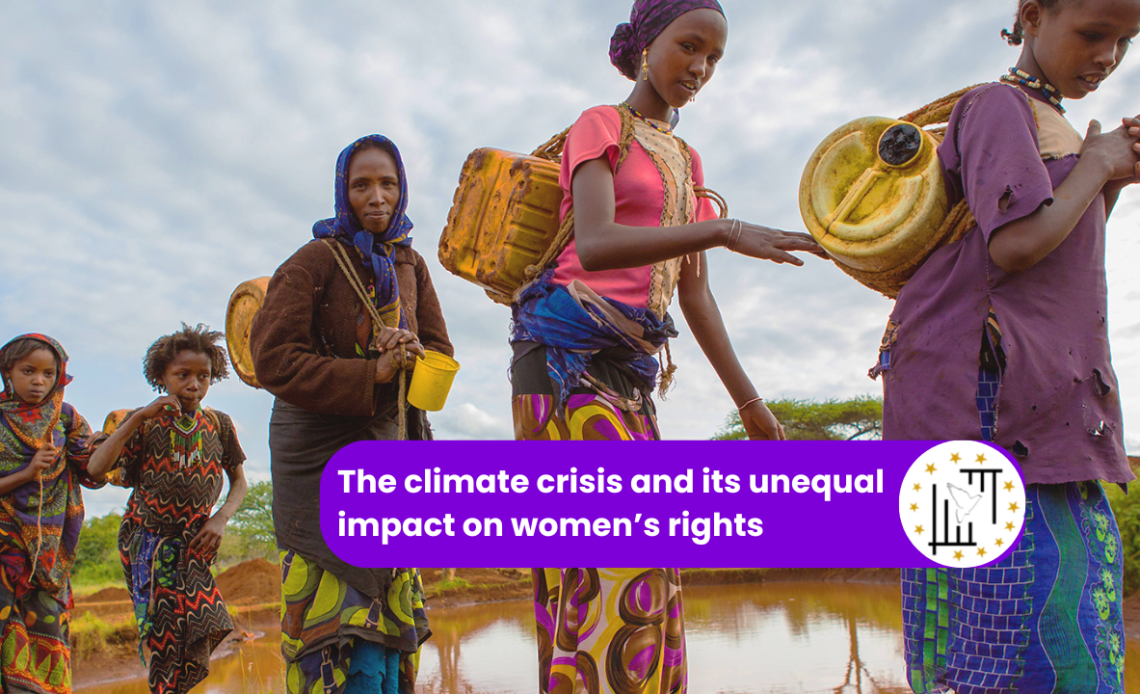
In many regions, women are primarily responsible for securing water and food for their households. In certain areas, climate change has reduced the availability of local water sources, forcing women to travel longer distances—sometimes to other communities or cities—to meet basic household needs. As environmental pressures intensify, this responsibility places a growing physical and economic burden on women. Moreover, the added pressure often affects young girls as well, who may be forced to drop out of school to help their mothers manage household duties.
These inequalities are reinforced by structural disparities in access to resources. A United Nations Development Program (UNDP) report on gender and climate change highlights that, although women constitute 40% of the agricultural labor force in the Global South, they own only 10–20% of the land. This disparity in land ownership reflects broader gender inequalities in access to property and financial assets.
In this context, women make up the majority of the global poor and often depend directly on natural resources as their primary source of food and livelihood, which makes them the first to suffer the consequences of environmental degradation. Moreover, currently, 47.8 million more women experience food insecurity and hunger compared to men, and climate change could push up to 156 million additional women and girls into poverty—16 million more than the total number of men and boys (UN Women, 2025).
Therefore, the structural barriers that women face, including their primary responsibility for securing food and managing household needs, coupled with limited access to land, property, and income-generating assets, constrain their economic opportunities and weaken their capacity to adapt to climate-related shocks. These inequalities not only increase women’s vulnerability to environmental stressors but also perpetuate cycles of poverty and disadvantage, with young girls often being the first to be forced to quit education as domestic responsibilities intensify.
Climate change increases gender-based violence
A new issue brief of the UN spotlight initiative warns that, without urgent action, climate change could be linked to one in every ten cases of intimate partner violence by the end of the century. The study presents preliminary findings that every 1°C rise in global temperature is associated with a 4.7 per cent increase in intimate partner violence.
While the link with climate change and gender-based violence is not a direct one, the increasing social insecurities resulting from climate change, such as scarce resources and extreme weather events, can indirectly contribute to gender-based violence. Research has already established a link between poverty and increased incidents of violence against women. In the context of the climate crisis, this pattern is explained by the environmental and economic stressors induced by climate change, including food and water scarcity and economic insecurity, which results in chronic stress and intensifies household tension and conflict. To illustrate, one study reported a 28 percent rise in femicide during heatwaves, reflecting the destabilizing effects of extreme climate conditions. Moreover, women’s heightened vulnerability to resource scarcity and their generally lower economic status increase their dependence on partners for financial support, making it more difficult to leave abusive relationships.
Furthermore, the effects of climate change not only increase tensions within households but also amplify political and economic instability in vulnerable regions, exacerbating forms of gender-based violence such as conflict-related sexual violence, human trafficking, and child marriage. Displacement caused by climate-related disasters further heightens the risk of sexual violence, with adolescent girls reporting high levels of harassment and a lack of privacy in emergency settings. Overall, climate change acts as a powerful threat multiplier that intensifies the structural inequalities that leave women and girls more vulnerable to violence.
The importance of gender-responsive climate action
As women disproportionately bear the burden of the climate crisis, their inclusion in decision-making and solution-building is essential. Gender-responsive climate action recognizes the unequal impacts of climate change on women and girls, making responses not only more equitable but also more effective. The United Nations estimates that 80 percent of displaced people are women, yet conditions in displacement camps often fail to address their specific needs. For instance, during the 2022 floods in Pakistan, an estimated 650,000 pregnant women were left without access to healthcare, forcing many to give birth in the open. At the same time, inadequate sanitation and limited resources prevent girls from accessing menstrual products and managing their periods with dignity. Without deliberate attention to these realities, humanitarian responses risk reinforcing existing patriarchal structures. Addressing the climate crisis, therefore, requires a feminist approach that places gender equality at its core.
The Climate Change Gender Action Plan (GAP), established under the United Nations Framework Convention on Climate Change (UNFCCC), seeks to integrate gender equality into climate policy and action. A key priority is ensuring women’s participation as agents of change, which is shown to improve the effectiveness and sustainability of solutions.
According to the Office of the United Nations High Commissioner for Human Rights (OHCHR), 55 percent of improvements in food security in the Global South over recent decades can be attributed to programs promoting women’s empowerment. This is particularly evident in Indigenous communities, where women play a central role in managing natural resources at both household and community levels. Their knowledge, experience, and close relationship with the environment provide critical insights for developing livelihood strategies that are resilient to changing environmental conditions.
Sources:
Baschieri, A., Udeh, C., Yunusa, Z., & Snow, R. (2025). Women, Girls, and the Climate Crisis: Advancing Reproductive Health and Rights and Gender Equality in Climate Policies at ICPD+30. Studies in Family Planning, 56(2), 301–316. https://doi.org/10.1111/sifp.70006
Climate Change’s Greatest Victims are Women and Girls. (2023, 8 december). unicef.org. Geraadpleegd op 20 maart 2026, van https://www.unicef.org/rosa/blog/climate-changes-greatest-victims-are-women-and-girls
Climate crisis driving surge in gender-based violence, UN study finds. (2025, 28 november). UN News. https://news.un.org/en/story/2025/04/1162461
Dalberg. (z.d.). COLLIDING CRISES: How the climate crisis fuels gender-based violence. https://spotlightinitiative.org/sites/default/files/publication/2025-08/Colliding%20Crises%20How%20the%20climate%20crisis%20fuels%20gender-based%20violence%202025.pdf?utm_source
Federal Ministry for Economic Cooperation and Development. (2021). CLIMATE CHANGE: PROTECTING WOMEN’S RIGHTS. https://www.ohchr.org/sites/default/files/Documents/Issues/ClimateChange/materials/2PGenderLight.pdf
How gender inequality and climate change are interconnected. (2025, 21 april). unwomen.org. Geraadpleegd op 20 maart 2026, van https://www.unwomen.org/en/articles/explainer/how-gender-inequality-and-climate-change-are-interconnected
Sanz-Barbero, B., Linares, C., Vives-Cases, C., González, J. L., López-Ossorio, J. J., & Díaz, J. (2018). Heat wave and the risk of intimate partner violence. The Science Of The Total Environment, 644, 413–419. https://doi.org/10.1016/j.scitotenv.2018.06.368
The Climate Change Gender Action Plan: What’s at stake at COP30. (2025, 11 november). unwomen.org. Geraadpleegd op 20 maart 2026, van https://www.unwomen.org/en/articles/explainer/the-climate-change-gender-action-plan-whats-at-stake-at-cop30
UNDP Guatemala. (z.d.). GENDER AND CLIMATE CHANGE. https://www.undp.org/sites/g/files/zskgke326/files/publications/UNDP%20Linkages%20Gender%20and%20CC%20Policy%20Brief%201-WEB.pdf
United Nations. (2022). Synthesis report by the secretariat. In Subsidiary Body For Implementation: Vol. Fifty-sixth (Synthesis report GE.22-08258(E); pp. 1–4). https://unfccc.int/sites/default/files/resource/sbi2022_07.pdf
United Nations Population Fund, Mgogwana, Y., Onabanjo, J., & Nkoana-Mashabane, M. (2019). SRHR, GENDER AND CLIMATE CHANGE RESILIENCE SYMPOSIUM. In Future Africa Campus, University Of Pretoria (pp. 3–37). https://esaro.unfpa.org/sites/default/files/pub-pdf/unfpa_climate_change_symposium_report.pdf