

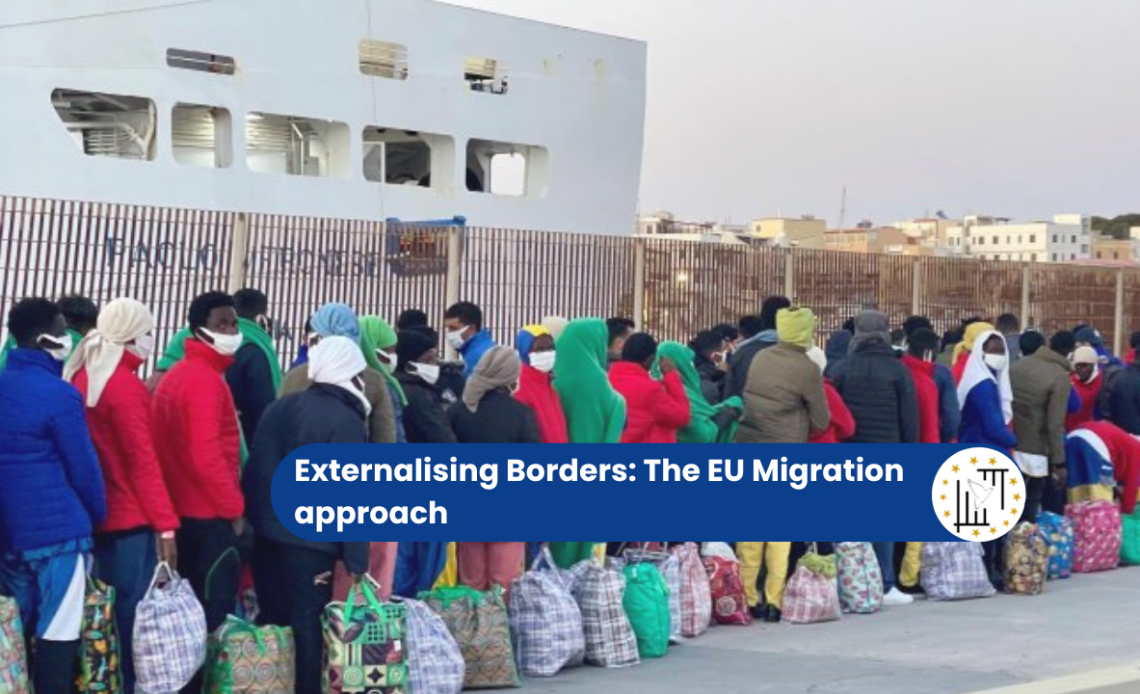
This contribution examines the recent and concerning direction taken by the European Union in the the process of Externalisation of Migration Issue started in 2020 with the Proposal from the European Commission on the Pact on Migration and Asylum, with particular attention to two separate amending regulations to Regulation (EU) 2024/1348: one establishing a Union-level list of safe countries of origin, and the other expanding the application of the “safe third country” concept.
It therefore has the potential to mark a significant shift in the EU’s asylum framework, with serious implications for fundamental rights, procedural safeguards and access to protection. The report focuses on (i) the process of Externalisation of Migration Issue carried out by EU Policies with the example of Italy (ii) the risks of the implementation of the two separate amending regulations to Regulation (EU) 2024/1348 (iii).
I The process of Externalisation of Migration Issue carried out by EU Policies with the example of Italy
In 2020, the European Commission released the proposal for the Pact on Migration and Asylum (European Commission), consisting of four main pillars: robust screening, the Eurodac asylum and migration database, border procedures and return, and crisis protocols and action against instrumentalisation. The proposal aims to align and reinforce EU measures on migration, asylum, border management, and integration through a unified policy approach. It has been negotiated for four years, with two years of transition to allow Member States to develop National Implementation Plans. In April 2026, the Pact will effectively enter into force. The Commission also implemented the Annual Migration Management Cycle to provide a comprehensive overview of the asylum and migration situation in the EU, identify the migratory situations Member States are facing, and propose an Annual Solidarity Pool to be adopted by the Council.
In parallel with the EU’s common response to migration flows, which began in 2015, Member States, which hold shared competences with the EU, have started bilateral external cooperation initiatives, such as Italy initiating a process of externalisation of the asylum procedure and, when necessary, return procedures. In 2017, the Italian Government signed a memorandum with Libya, automatically renewed in 2022, which also included economic cooperation with the Libyan Coast Guard. The memorandum states: “The Italian side undertakes to provide technical and technological support to the Libyan authorities responsible for combating irregular migration, represented by the Border Guard and the Coast Guard of the Ministry of Defense,” as well as “financing of the aforementioned reception centres already in operation, in compliance with the relevant regulations, using available funding from Italy as well as funding from the European Union.” Otherwise, some international organisations, such as IOM, reported illegal treatment and detention.
In 2023, the Prime Minister of Italy, Meloni, and the Albanian Prime Minister, Edi Rama, announced that they had reached a deal for Rome to hold up to 3,000 irregular migrants rescued from the Mediterranean in two holding centres in Albania, with the aim of keeping healthy adult men applying for international protection housed there until their cases have been decided. The Italian government expected to spend around 670 million euros over five years, but since the centres were built, three attempts by the Italian authorities to make the Italy-Albania deal work failed due to Italian court decisions.
It is not clear whether the process will work in the coming years, and the functioning of the centres themselves remains rather unclear. An employee of one of the two centres showed his contract to EUobserver, highlighting Article 11 of the contract, which refers first to “Confidentiality,” followed by the “Obligation of loyalty,” which requires workers to keep secret all information relating to the employer’s business that comes to their knowledge during their period of employment.
The cause of the inefficiency of these centres is connected with the definition of Safe Third Countries and with the question of whether a European state could detain asylum seekers outside EU territory.
II The risks of the implementation of the two separate amending regulations to Regulation (EU) 2024/1348
The proposals on the EU list of safe countries of origin and on the application of the safe third country concept do not form part of the original legislative package of the New Pact on Migration and Asylum, but were tabled at a later stage as subsequent amendments to Regulation (EU) 2024/1348, which was adopted as part of the Pact.
The first proposal proposes the establishment of a common EU list of safe countries of origin: its objective is to harmonise Member States’ by introducing a common list of countries which are considered by the European Commission to be safe for their nationals. Applications from asylum seekers coming from these countries may therefore be examined under accelerated procedures, subject to individual assessment and rebuttal of the presumption of safety. The proposal aims to neutralize divergences between national lists and to enhance procedural efficiency within the Common European Asylum System.
The safe third country concept allows EU Member States to reject an asylum application as inadmissible, without examining its substance, where asylum seekers could have sought and, if eligible, received international protection in a non-EU country that is considered safe for them.
Under this amendment, Member States may apply the safe third country concept on the basis of three alternative grounds: the existence of a connection between the applicant and the third country (which is no longer a mandatory requirement), the applicant’s prior transit through that country, or the existence of an agreement or arrangement with a safe third country ensuring that the asylum application will be examined there.
This last element is particularly important because perfectly reflect the intentions of the EU to make political deals with third countries which are considered not safe for migrants from impartial international organisations, and one of the clearest examples could be the memorandum of understanding between Libya and the Italy
Taken together, the two proposals aim to strengthen the efficiency and predictability of asylum procedures under the New Pact on Migration and Asylum by expanding the use of presumptions of safety, while raising significant legal and policy questions regarding procedural guarantees, access to remedies, and compliance with international refugee and human rights law.
III The political and normative critique of the Pact: the perspective of Damien Carême
A critical and politically grounded perspective on the process of externalisation of migration governance is offered by Damien Carême, Member of the European Parliament and former mayor of Grande-Synthe in northern France. His political trajectory, situated between local governance and European policymaking, provides a relevant lens through which to assess the broader implications of the New Pact on Migration and Asylum.
Carême frames the Pact not merely as a technical reform of the Common European Asylum System, but as a symptom of a deeper transformation within the European Union: the Agreement risks consolidating a model increasingly oriented toward containment, deterrence and external displacement of responsibility, rather than reinforcing solidarity among Member States. From this perspective, the Pact reflects a political need to demonstrate control over migratory movements in a context of geopolitical instability and rising nationalist pressures.
The negotiation process itself, which lasted several years, revealed significant tensions between efficiency-driven migration management and compliance with fundamental rights obligations. According to Carême, serious concerns emerged regarding compatibility with the European Convention on Human Rights, particularly in relation to accelerated border procedures and the expansion of inadmissibility grounds. These tensions highlight a structural contradiction within the Pact: the attempt to simplify procedures and increase returns may weaken procedural guarantees and individualized assessment of asylum claims.
Particular attention must be paid to the mechanisms that operationalize externalisation. The reinforcement of external borders, the expansion of screening procedures at entry points, the development of EU-wide lists of safe countries of origin, and the broader application of the safe third country concept collectively contribute to a system in which access to protection risks being progressively restricted. The extension of biometric data collection within the Eurodac system further illustrates a shift toward securitization and intensified data governance.
Carême’s critique is especially relevant in light of the amendments to Regulation (EU) 2024/1348 previously examined. The establishment of a Union-level list of safe countries of origin may lead to accelerated procedures based on presumptions of safety that are difficult to rebut in practice. Similarly, the expanded application of the safe third country concept, particularly where the requirement of a meaningful connection between the applicant and the third country is weakened, facilitates the relocation of asylum seekers to states outside the EU, often through bilateral political arrangements.
Carême also contrasts this restrictive approach with the European response to the mass displacement of Ukrainian nationals in 2022. The rapid activation of exceptional protection mechanisms, granting access to employment, social services and civic integration, demonstrated that a solidarity-based model is operationally feasible when political will is present. This comparison underscores a central normative question: whether differentiated treatment based on nationality or geopolitical proximity is compatible with the universalistic foundations of international refugee law.
In this sense, Carême’s perspective reinforces the core concern of this report: that the current trajectory of EU migration governance, and particularly the expansion of presumptions of safety and third-country responsibility, may significantly alter the balance between efficiency and rights protection within the Common European Asylum System. The absence of a comprehensive impact assessment on the human, legal and social consequences of these reforms further amplifies the uncertainty surrounding their implementation.
At the same time, municipal initiatives, civil society engagement and strategic litigation before the European Court of Human Rights remain essential tools to ensure that international and European legal standards continue to function as effective safeguards. In this context, international law represents a crucial normative anchor in a context where political compromises increasingly prioritize migration containment over access to protection.
Taken together, this political critique complements the legal analysis developed in the previous sections. It highlights that the process of externalisation is not merely a technical reconfiguration of competences, but a broader redefinition of the European Union’s approach to asylum, that raises fundamental questions about solidarity, responsibility-sharing and the future of protection within the EU legal order.
Sources
Memorandum d’intesa sulla cooperazione nel campo dello sviluppo, del contrasto all’immigrazione illegale, al traffico di esseri umani, al contrabbando e sul rafforzamento della sicurezza delle frontiere tra lo Stato della Libia e la Repubblica Italiana. https://www.governo.it/sites/governo.it/files/Libia.pdf
IOM Emergency Teams Support Migrants in Libya Following Discovery of Mass Grave and Underground Detention Sites. (2026). International Organization for Migration. https://www.iom.int/news/iom-emergency-teams-support-migrants-libya-following-discovery-mass-grave-and-underground-detention-sites
Figoni, L., Millona, K., & Rondi, L. (2025, October 14). Italy-Albania migrant deal: Millions spent, few results. EUobserver. https://euobserver.com/30225/italy-albania-migrant-deal-millions-spent-few-results/
Safe third country: Council and European Parliament agree on new EU law restricting admissibility of asylum claims. (2025). Council of the EU. https://www.consilium.europa.eu/en/press/press-releases/2025/12/18/safe-third-country-council-and-european-parliament-agree-on-new-eu-law-restricting-admissibility-of-asylum-claims/