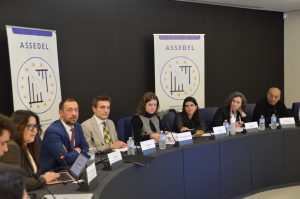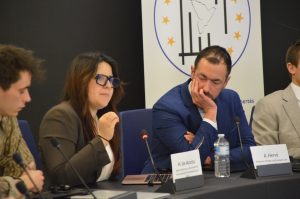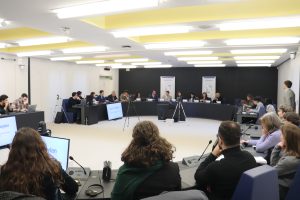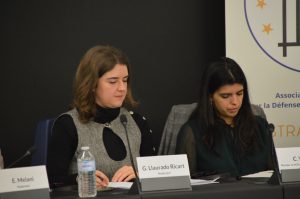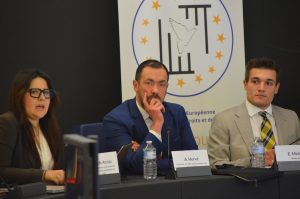
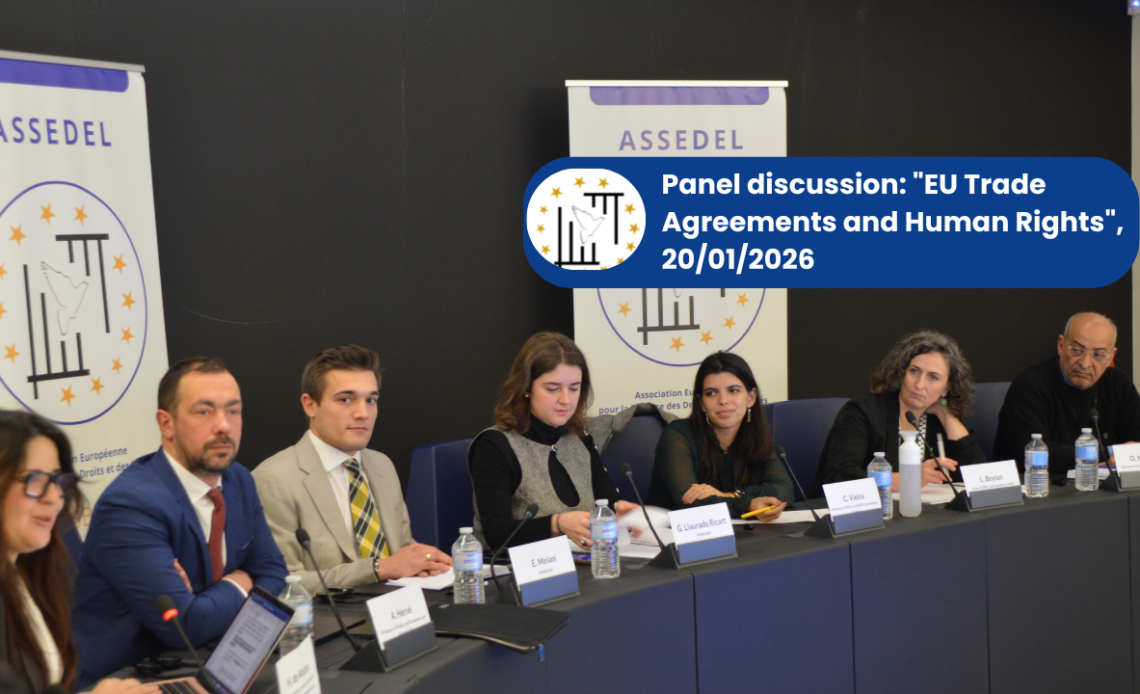
Nous sommes fiers d’annoncer que la table ronde d’ASSEDEL, « Accords commerciaux de l’UE et droits de l’homme », s’est tenue le mardi 20 janvier au Parlement européen à Strasbourg,th co-organisée par l’eurodéputée Catarina Vieira (Groupe des Verts/ALE), membre des commissions INTA et DROI. L’événement avait pour objectif d’examiner comment l’Union européenne intègre les droits de l’homme et les principes démocratiques dans ses accords commerciaux, avec une attention particulière portée aux régions contestées, notamment le Sahara occidental et la Palestine. Sous un angle juridique et éthique, le panel a exploré les tensions entre les intérêts économiques et les obligations en matière de droits de l’homme, et a examiné ce que ces défis révèlent sur l’approche de l’Union européenne en matière de politique commerciale responsable et fondée sur des valeurs. Quatre principaux sujets ont été abordés : le rôle et l’efficacité des clauses relatives aux droits de l’homme dans les accords commerciaux, les doubles standards dans les accords commerciaux, une étude de cas sur l’accord commercial UE-Maroc et le Sahara occidental, et la question de savoir si le commerce éthique est un objectif réaliste ou simplement un engagement symbolique.
Nous avons eu l'honneur d'accueillir des experts de premier plan dans ce domaine.
Concilier commerce et droits : l’eurodéputée Catarina Vieira sur les défis de la responsabilité de l’UE dans la politique économique mondiale
L’eurodéputée Catarina Vieira a ouvert le panel en expliquant que le commerce est de plus en plus instrumentalisé pour faire avancer des intérêts économiques et géopolitiques étroits, en soulignant la montée des menaces tarifaires, l’intensification des rivalités mondiales de pouvoir et la tendance croissante à privilégier les objectifs économiques au détriment des droits civils et humains.
S’agissant du contexte européen, elle a critiqué la domination des discours sur la compétitivité et du lobbying industriel dans l’élaboration de la politique commerciale, avec un nombre croissant d’accords conclus avec des partenaires affichant de mauvais bilans en matière de droits humains et des protections environnementales faibles. Mme Vieira a également souligné la contradiction entre l’engagement déclaré de l’UE en faveur des droits humains et ses pratiques, citant comme exemples illustratifs l’Accord d’association UE-Israël et l’Accord commercial UE-Maroc. Elle a en outre exprimé son inquiétude quant à l’affaiblissement des mécanismes juridiques internes, y compris la loi sur le devoir de vigilance des entreprises, ce qui compromet la responsabilité en cas de violations des droits humains dans les chaînes d’approvisionnement mondiales.
Tout en reconnaissant l’importance du commerce pour le rôle mondial de l’UE, elle a souligné que l’engagement économique ne doit pas se faire au détriment des droits humains contraignants et des obligations du droit international, concluant en insistant sur la nécessité de responsabilité et de mécanismes de contrôle plus efficaces.
Le professeur Alan Hervé sur l’évolution et les défis des droits humains dans la politique commerciale de l’UE
Ensuite, l’intervention du professeur Hervé a replacé l’intégration des droits humains dans les accords commerciaux de l’UE dans son contexte historique.
L’inclusion de clauses relatives aux droits humains a évolué au fil du temps, avec des origines dans les années 1990. Notamment, l’Accord d’association UE-Tunisie (art. 2) stipulait que le respect des principes démocratiques et des droits humains constitue un élément essentiel. De plus, en vertu du droit international coutumier, la violation de ces éléments essentiels ouvre la possibilité de dénoncer ou de suspendre les accords de libre-échange (ALE). Après le traité de Lisbonne (2009), l’accent s’est déplacé vers les chapitres « Commerce et développement durable » (TSD). Ces chapitres couvrent les droits sociaux et les normes environnementales, incluant par exemple les références à l’élimination du travail des enfants.
Le professeur Hervé a expliqué en outre que, si dans certains accords de libre-échange le respect des droits humains constitue un élément essentiel, dans d’autres il n’y a aucune référence aux droits humains, comme c’est le cas dans l’accord UE-Royaume-Uni, ce qui soulève des questions critiques de double standard.
Il souligne surtout les limites de la mise en œuvre effective de ces clauses relatives aux droits humains dans les accords commerciaux. Si cette mise en œuvre est souvent entravée par des mécanismes non contraignants et un manque de mécanismes de contrôle robustes, elle dépend aussi fortement de la volonté politique de l'Union européenne d'agir en cas de violation des droits humains dans ses accords commerciaux. Enfin, il a de nouveau évoqué l'existence de deux poids, deux mesures, se demandant si les violations des droits humains se limitent aux partenaires commerciaux de l'UE ou si l'UE elle-même est complice.
Intervention de l’eurodéputée Lynn Boylan : les doubles standards dans les accords commerciaux de l’UE
L’eurodéputée Lynn Boylan a également proposé une perspective critique sur l’écart entre la rhétorique de l’UE et la réalité, en mettant particulièrement l’accent sur les territoires occupés, la Palestine et le Sahara occidental. Elle souligne que, si le multilatéralisme et les droits humains étaient des principes fondateurs de l’Union européenne, en pratique l’UE s’est éloignée de la promotion des droits humains dans ses accords commerciaux. Aujourd’hui, le commerce est de plus en plus motivé par le profit et les intérêts géopolitiques plutôt que par le respect du droit international. S’appuyant sur ses fonctions au sein de la commission INTA et en tant que présidente de la délégation du Parlement pour les relations avec la Palestine, elle a souligné que le commerce de l’UE avec Israël constitue une forme de complicité dans le génocide à Gaza et l’occupation illégale du territoire palestinien. Cela constitue une violation manifeste de l’article 2 de l’Accord d’association UE-Israël, qui stipule que le respect des droits humains et des principes démocratiques constitue un élément essentiel de l’accord. Malgré cette clause, l’UE poursuit ses échanges commerciaux comme si de rien n’était, ignorant à la fois les dispositions relatives aux droits humains dans l’accord et l’avis consultatif de la CIJ de juillet 2024, qui oblige les États à s’abstenir de toute activité économique ou commerciale consolidant la présence illégale d’Israël.
S’agissant du Sahara occidental et de son rôle de rapporteure permanente pour la région du Maghreb au sein de la commission INTA, Mme Boylan a expliqué comment la Commission a de la même manière ignoré les décisions de la Cour de justice de l’Union européenne (CJUE) et le droit à l’autodétermination du peuple sahraoui en avançant des amendements à l’Accord UE-Maroc sans consulter le Front Polisario, le mouvement légitime représentant le peuple sahraoui dans sa lutte pour l’autodétermination. Dans une tentative de se conformer au jugement de la Cour, la Commission a proposé de financer les secteurs clés de la région, notamment l’irrigation et l’énergie, tout en étendant l’aide humanitaire aux camps de réfugiés de Tindouf, instrumentalisant ainsi l’assistance humanitaire. Comme le financement n’est pas soumis à un principe de différenciation, il bénéficiera aux colons marocains et aux entreprises opérant illégalement sur le territoire, et finira par encourager l’occupation illégale.
Dans l’ensemble, ces exemples révèlent une politique commerciale de l’UE incohérente, pratiquant une sélection arbitraire dans l’intégration des droits humains. Cela mine en fin de compte la crédibilité de l’UE et la place dans une position géopolitique difficile. Mme Boylan appelle à un changement de paradigme fondamental dans la politique commerciale de l’UE, soutenant que l’intégration cohérente des droits humains et du droit international n’est pas seulement un impératif moral, mais constitue également un enjeu crucial pour protéger la crédibilité de l’UE tant sur le plan géopolitique que juridique international.
Omar Mansour sur le commerce UE-Maroc et les droits sahraouis
L’intervention d’Omar Mansour, ambassadeur de la République sahraouie, a rappelé que le Sahara occidental est un territoire non autonome sous la responsabilité de l’ONU et que son peuple dispose d’un droit à l’autodétermination reconnu au niveau international, réaffirmé par l’ONU, la Cour internationale de Justice et la CJUE.
Il a souligné que la consultation ne vaut pas consentement et que la plus haute juridiction de l’UE a constamment statué qu’aucun accord avec le Maroc ne peut légalement s’appliquer au Sahara occidental sans le consentement explicite de son peuple. Pourtant, les accords commerciaux UE-Maroc ont exploité les ressources sahraouies sans consentement approprié. Cela profite à des acteurs externes tout en excluant le peuple sahraoui et en violant ses droits humains, y compris sa souveraineté sur les ressources naturelles. D’un point de vue des droits humains, cette situation est alarmante. La souveraineté permanente sur les ressources naturelles est une obligation légale, et les accords commerciaux qui l’ignorent risquent de transformer la coopération économique en un outil qui aggrave, plutôt que de remédier à, une situation illégale.
Faisant écho à Mme Boylan, M. Mansour critique l’incohérence de l’UE dans l’application de ses obligations en matière de droits humains et avertit que le non-respect des décisions claires de la CJUE compromet non seulement la crédibilité de l’Union en droit international, mais affaiblit également sa position en tant qu’acteur normatif dans la gouvernance mondiale.
Pour conclure, et en tant que représentant du Front Polisario, il exhorte l’Union européenne à respecter les décisions de sa Cour, à exclure le Sahara occidental des accords UE-Maroc sans le consentement de son peuple, à garantir une étiquetage transparent des produits et à aligner pleinement sa politique commerciale sur ses obligations en matière de droits humains.
Hélionor de Anzizu (CIEL) sur l’alignement du commerce de l’UE avec les droits humains et la durabilité
L’intervention d’Anzizu a apporté une dimension plus optimiste à la discussion, expliquant que le commerce peut (et doit) fonctionner non seulement sur le plan économique, mais aussi comme un outil pour promouvoir des pratiques éthiques et durables à l’échelle mondiale.
Elle a souligné la capacité de l’UE à utiliser le commerce comme instrument diplomatique, en utilisant l’accès aux avantages commerciaux pour encourager la ratification des traités sur les droits humains et l’environnement. Cette approche permet à l’UE d’influencer les pays partenaires sans recourir à la coercition tout en répondant à la demande croissante du public pour des chaînes d’approvisionnement éthiques.
Elle a également souligné l’importance de la responsabilité dans la chaîne d’approvisionnement, en insistant sur le fait que la libéralisation du commerce peut améliorer les droits humains grâce à l’emploi et à la croissance économique, mais qu’un commerce inconditionnel risque d’encourager des abus.
Elle a conclu que les droits humains constituent un outil de levier puissant en matière de politique étrangère, efficace uniquement si l’UE les place systématiquement au cœur de ses accords commerciaux, en alignant le commerce sur des objectifs éthiques et stratégiques.
Intervention de Pichamon Yeopantong, experte indépendante du Groupe de travail des Nations Unies sur les entreprises et les droits de l’homme
La contribution de Mme Yeopantong souligne que le commerce n’est pas simplement un échange de biens ou de capitaux, mais un processus qui affecte profondément les personnes (travailleurs, agriculteurs, communautés autochtones et familles), qui sont les véritables titulaires de droits, façonnés par les termes et les impacts des accords commerciaux. Dans cette perspective, la politique commerciale est intrinsèquement une question de droits humains, et sa légitimité dépend de sa capacité à respecter ou à compromettre les droits de ceux qui sont concernés.
Elle revient également sur les efforts déployés par l’UE au cours des dernières décennies pour intégrer les droits humains dans ses cadres commerciaux, tout en soulignant que le véritable défi réside dans la mise en œuvre et la cohérence. L’inclusion de clauses relatives aux droits humains seule est insuffisante si elles ne sont pas appliquées de manière rigoureuse et uniforme. Dans ce contexte, Mme Yeopantong met en garde contre le fait que, si l’UE cherche à renforcer sa compétitivité mondiale, cet objectif ne doit pas servir de prétexte pour abaisser les normes ou marginaliser les perspectives en matière de droits humains.
Comme l’a également souligné Mme Anzizu, Mme Yeopantong conclut en réaffirmant que les accords commerciaux, lorsqu’ils sont véritablement conçus et mis en œuvre avec les droits humains au cœur de leur démarche, peuvent constituer de puissants instruments de changement positif et renforcer le rôle de l’UE en tant qu’acteur mondial engagé dans un commerce durable et fondé sur les droits humains.
En résumé, la discussion du panel ASSEDEL a mis en lumière à la fois le potentiel et les défis liés à l’alignement de la politique commerciale de l’UE sur les droits humains. Bien que les accords commerciaux de l’UE incluent de plus en plus de clauses relatives aux droits humains, leur mise en œuvre incohérente, le manque de volonté politique et la priorité accordée aux intérêts économiques ou géopolitiques compromettent souvent ces engagements, en particulier dans des régions contestées comme le Sahara occidental et la Palestine. En même temps, le panel a présenté une vision constructive : lorsque les accords commerciaux sont conçus et appliqués avec les droits humains et la durabilité au cœur de leur démarche, ils peuvent constituer des instruments de changement positif et renforcer la crédibilité de l’UE en tant qu’acteur normatif sur la scène mondiale.