

Europe prides itself on its democratic standards. Yet precisely where democracy begins for most citizens — in towns, cities, and regions — a crucial layer of protection is missing. The European Convention on Human Rights guarantees free elections, but only for national parliaments. Local and many regional elections fall outside its scope. This means that cases of election interference or corruption, which we have been seeing with increasing frequency lately, cannot be heard by the European Court of Human Rights, leaving a significant gap in our democratic resilience.
For years, this gap was treated as a technicality. Today, it is becoming a structural vulnerability. In an era marked by political polarisation, disinformation, and foreign interference, the question is becoming unavoidable: Is Europe doing enough to protect democracy where it is most exposed?
A voice of experience raises the alarm
Few people observe Europe’s democratic landscape as closely as Stewart Dickson. As a long‑standing member of the Congress of Local and Regional Authorities of the Council of Europe, he is serving as rapporteur on the topic of free local and regional elections. His work takes him into election commissions, municipal councils, and politically tense environments across the continent.
During the 50th session of the congress of local and regional authorities, ASSEDEL had the opportunity to talk with him closer about his report on the protection of local elections, where he explains why the protection gap matters.
Studies show that local and regional institutions in the EU are more trusted than national ones. But this trust is increasingly under strain: “that confidence is eroded when you have malign actors, organisations or people who want to corrupt those local and regional elections.” For Dickson, the conclusion is clear: local and regional elections should be placed under the same human‑rights protection as parliamentary elections.
Why local elections have become a frontline
The Congress’ recent observation missions shows that local elections are no longer insulated from broader democratic threats. Manipulated voter lists, politically influenced election administrations, misuse of public resources, and pressure on candidates are becoming more common. Dickson confirms this shift: “Local and regional elections are very much in the front line of the threats against democracy.”
One of the biggest drivers is the transformation of the information environment. “Particularly with regards to social media, which is so local,” he explains. In the past, people relied on local newspapers or printed materials. Today, influence can come from anywhere. “You get bad social media actors even from outside your state or outside the region where the election is being conducted.” The effect on voters can be profound: “Once you hook into something in social media, the algorithms continue to build on that.”
This example shows clearly why local elections are especially vulnerable and why the lack of legal protection at European level is so concerning.
Georgia: A warning Europe cannot ignore
When asked for a concrete example, Dickson does not hesitate. “The situation for example in Georgia is a very difficult one,” he says. The Congress’ fact‑finding visit to Georgia in 2025 documented a rapid deterioration of democratic conditions. Dickson summarises the core problem: “The government has made numerous changes to the electoral law, none of which has been internationally assessed.”
International bodies, including the Venice Commission, have raised concerns. “Organisations like us or the Venice Commission are saying that the way in which these changes have been made are blatantly such that they are corrupting the election process.” The consequences are visible: “You’ve seen arrests, you’ve seen people put into custody, you’ve seen mayors put into prison.”
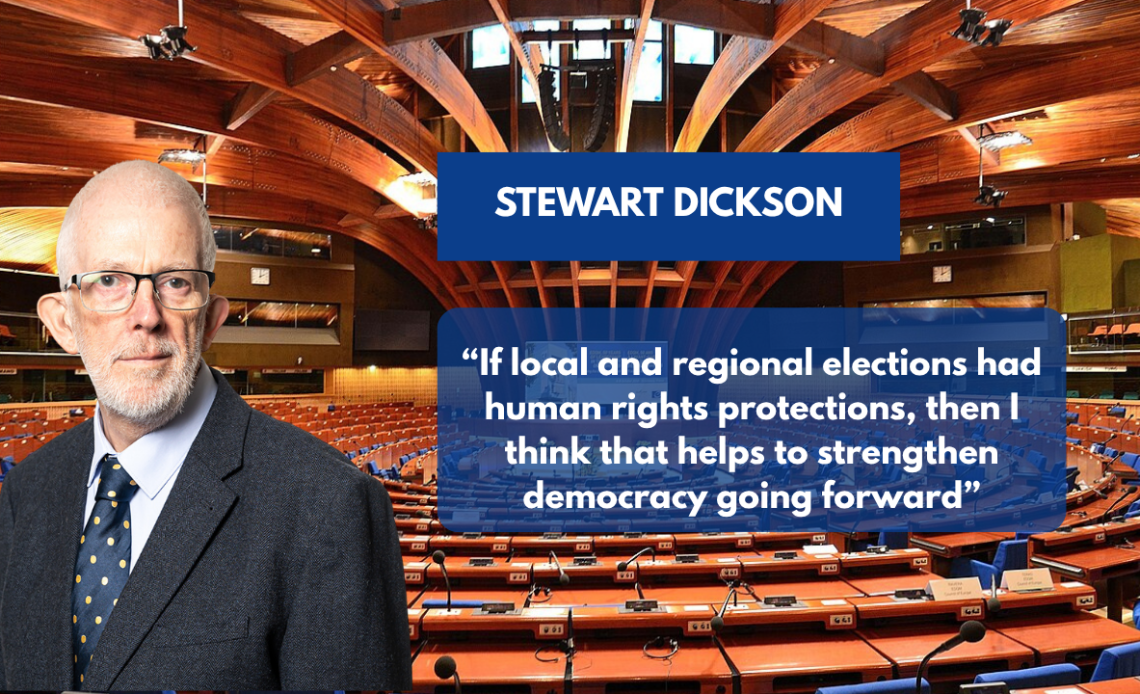
For Dickson, Georgia illustrates how powerful the forces undermining local democracy can be and how urgently stronger protections are needed. “If local and regional elections had human rights protections in the same way as parliamentary elections, then I think that helps to strengthen democracy going forward.”
The New Democratic Pact: A strong signal, but not a shield
The Council of Europe’s New Democratic Pact aims to reinforce democratic safeguards across all levels of governance. Dickson sees this as an important step. “The New Democratic Pact is sending out a very strong signal that we have seen this sort of creeping presence of malign influences in the electoral processes.”
He points to recent developments in Serbia as an example of how election integrity can be undermined: “Hundreds, what could really be thousands, of what could only be described as bogus election observers had been set up there — not to really observe the election, but to intimidate the people that were going to vote.”
Even genuine observers were affected: “Some of our own independent observers were made very uncomfortable when they were observing the elections.” The Pact acknowledges these threats but it does not yet close the protection gap for local elections.
A Call to Strengthen Local Democracy
The debate around the protection gap is no longer a technical discussion reserved for legal experts, it is becoming a defining test of Europe’s democratic credibility. Local and regional elections are where democratic trust is built, where political participation begins, and where interference can cause the deepest long‑term damage. As Stewart Dickson’s warnings make clear, Europe cannot afford to treat this level of governance as a secondary arena.
The New Democratic Pact signals that the Council of Europe has recognised the scale of the challenge. But signalling alone will not close the gap. Ensuring that local and regional elections fall under the same human‑rights protections as national ones would not only strengthen legal safeguards; it would reaffirm a simple democratic principle: every vote deserves equal protection, regardless of where it is cast.
If Europe wants to remain resilient in an age of disinformation, foreign influence, and eroding trust, it must reinforce democracy where it is lived every day. The protection of local elections is no longer a niche concern — it is a cornerstone of democratic security. The question now is whether Europe will act with the urgency the moment demands.
You can find the full interview on our YouTube channel.
Sources
Dickson, S. (2026): Free Elections at Local and Regional Levels. A Fundamental Right to Strengthen Grassroots Democracy, https://search.coe.int/cm#{%22CoEIdentifier%22:[%2209125948802afc3c%22],%22sort%22:[%22CoEValidationDate%20Descending%22]
Dickson, S. (2026): Report on the fact-finding visit to Georgia (24-25 September 2025), https://search.coe.int/cm#{%22CoEIdentifier%22:[%2209125948802b27b6%22],%22sort%22:[%22CoEValidationDate%20Descending%22]
Groupe d’études géopolitiques (2022): The Scale of Trust: Local, Regional, National and European Politics in Perspective, https://geopolitique.eu/en/2022/07/13/the-scale-of-trust-local-regional-national-and-european-politics-in-perspective/