

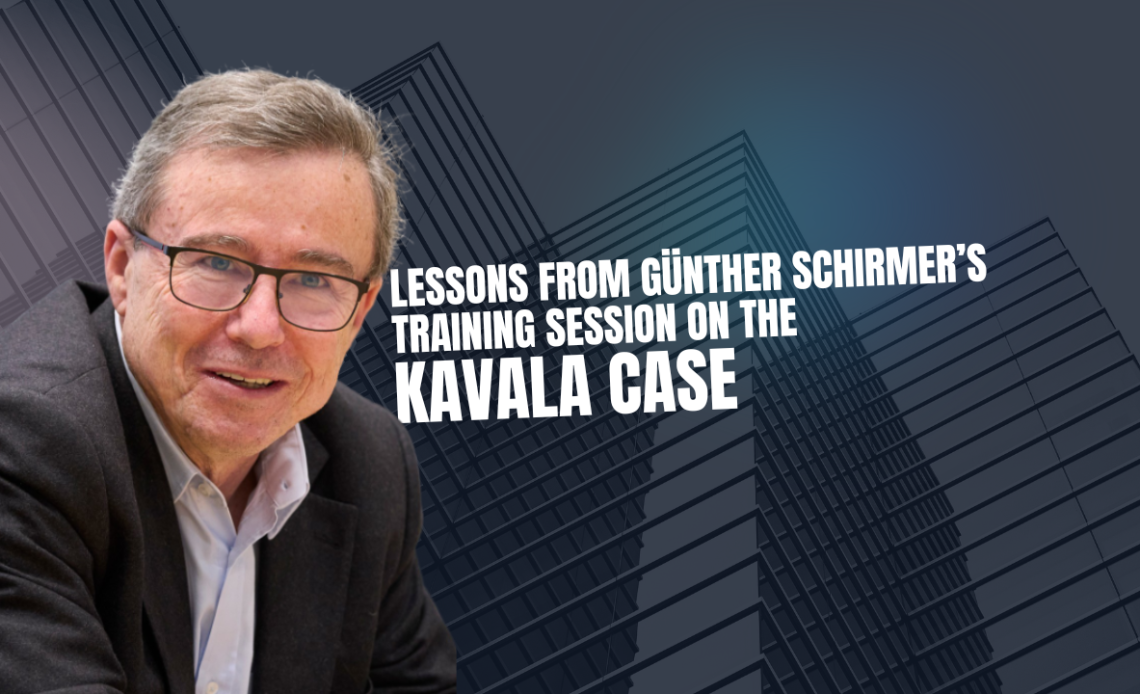
The Council of Europe is widely regarded as Europe’s most important guardian of human rights, democracy, and the rule of law. Yet, as became evident during a training session with Günther Schirmer, the institution operates in a political landscape where legal principles often collide with state interests. Schirmer’s reflections offered a rare insight into these tensions, with the case of Osman Kavala v. Turkey emerging as one of the most emblematic examples of arbitrary detention and resistance to international human rights obligations.
Günther Schirmer’s authority on these matters is rooted in his long career within the Parliamentary Assembly of the Council of Europe. For many years, he served as the Head of the Secretariat of the Committee on Legal Affairs and Human Rights, one of the Assembly’s most influential bodies. In this role, he coordinated rapporteurs, supervised the drafting of reports on politically sensitive issues, and advised parliamentarians on the legal and political implications of human rights violations. His work brought him into direct contact with cases involving political prisoners, systemic rule‑of‑law erosion and non‑compliance with judgments of the European Court of Human Rights (ECtHR).
The Case of Osman Kavala: A Symbol of Shrinking Civic Space in Turkey
Among the many cases Schirmer discussed, the situation of Osman Kavala stands out as a defining example of the limits of international human rights enforcement. Kavala, a prominent Turkish philanthropist and civil society figure, was arrested in October 2017. He was accused of attempting to overthrow the constitutional order, with allegations linked to the Gezi Park protests of 2013 and the attempted coup of 2016. These accusations were widely regarded as politically motivated and unsupported by credible evidence. Kavala’s arrest quickly became a symbol of the shrinking space for civil society in Turkey and the increasing use of judicial mechanisms to silence dissent.
The ECtHR Judgment: A Rare and Powerful Intervention
On 10 December 2019, the European Court of Human Rights issued a landmark judgement. The Court found that Kavala’s detention was arbitrary, that the charges lacked any reasonable suspicion, and that the detention pursued an ulterior political purpose: namely, to silence a critical civil society actor. The Court concluded that Turkey had violated Article 5 of the European Convention on Human Rights, which protects the right to liberty, and Article 18, which prohibits the misuse of legal restrictions for political ends. Although such orders are rare, the ECtHR is legally empowered to require the immediate release of a detainee when this is the only effective way to end a Convention violation. This authority derives from Article 46 of the Convention, which makes the Court’s judgments binding on member states. In cases where detention is found to be politically motivated — as in Kavala’s case — the Court may conclude that no other remedy is adequate. This is why the Court took the exceptional step of ordering Kavala’s immediate release.
Despite the binding nature of the judgment, Turkish authorities refused to release Kavala. This refusal triggered the infringement procedure under Article 46 § 4 of the Convention, a mechanism used only once before in the Council of Europe’s history. The case has since become a symbol of the broader challenge the institution faces when member states openly disregard their legal obligations. It also illustrates the limits of international mechanisms when confronted with determined political resistance.
Beyond Kavala: Other Politically Sensitive Human Rights Challenges
Schirmer also addressed other politically sensitive issues that reveal the complexity of the Council of Europe’s work. He referred to investigations into illegal transfers and secret detentions during the so‑called “War on Terror,” including the case of a German citizen of Lebanese origin who was wrongfully accused of planning a terrorist attack. After a year of torture and unlawful detention, the mistake was acknowledged, yet authorities refused to facilitate his return to Germany. This example highlighted the political sensitivity and institutional resistance that often accompany inquiries into counter‑terrorism abuses.
He also described situations in which strong evidence did not prevent political resistance within the Parliamentary Assembly. In one case, investigators had successfully demonstrated the accuracy of their findings, yet the Assembly ultimately voted against the report due to political pressure. Such episodes reveal how political dynamics can undermine the institution’s ability to act on its own principles.
Institutional Vulnerabilities: Lobbying, Security Risks, and Public Misconceptions
Schirmer noted that the Council of Europe is often underestimated in public discourse, despite its essential role in shaping human rights standards across the continent. At the same time, delegations operating in conflict zones frequently face security risks. Although they are formally protected by international guarantees, these protections are not always ensured in practice. In some missions, protection was provided by Russian special forces, creating operational and political complications.
He also addressed institutional vulnerabilities, including the influence of lobbying within the Parliamentary Assembly. Even when certain positions initially appear inadmissible, intensive lobbying efforts can reshape amendments and alter the final content of reports. The case of Pedro Agramunt demonstrated how political interests can infiltrate human rights processes.
A Fundamental Question: Human Rights Institution or Geopolitical Actor?
The session concluded with a broader reflection on the nature of the Council of Europe itself. Schirmer posed a fundamental question: is the Council of Europe purely a human rights institution, or does it also function as a geopolitical tool that advances certain humanitarian agendas under an institutional framework? This question captures the tension between the Council’s normative mission and the political realities it must navigate.
The training session with Günther Schirmer offered a comprehensive and nuanced understanding of the political complexities surrounding the Council of Europe’s human rights work. The Kavala v. Turkey case, in particular, illustrates both the strength of the ECtHR’s legal authority and the limitations the institution faces when confronted with state non‑compliance. For ASSEDEL, Schirmer’s insights underscore the importance of rigorous documentation, strategic advocacy, and sustained engagement with international mechanisms to ensure that human rights violations are addressed even in politically sensitive contexts.