

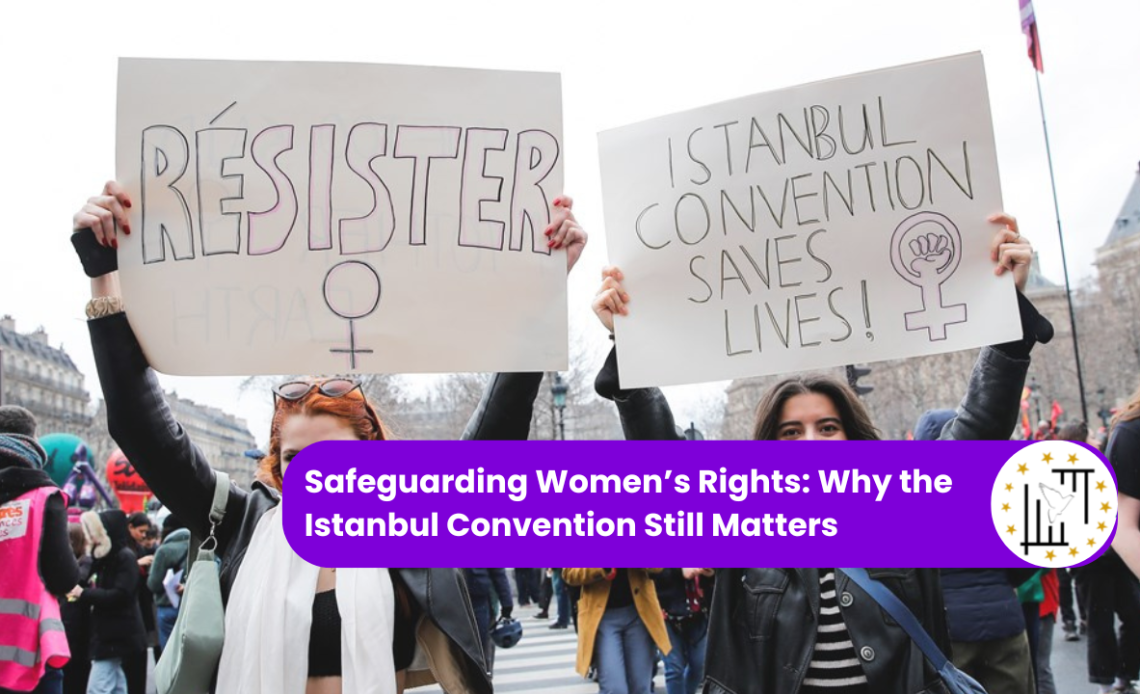
The Convention on Preventing and Combating Violence against Women and Domestic Violence, better known as the Istanbul Convention, is a landmark European treaty aimed at eliminating violence against women. The Convention emerged from efforts by the Council of Europe to strengthen the protection of women, beginning in the 1990s. National reports and data revealed both the magnitude of the problem and significant disparities in how states respond to such violence. Calls for action intensified, with growing political support for harmonizing legal standards across Europe to guarantee the same level of protection for victims.
In response, the Council of Europe recognized the need to establish comprehensive legal standards to prevent and combat violence against women and domestic violence. The convention was adopted on 7 April 2011 by the Committee of Ministers of the Council of Europe, and entered into force in August 2014. From that point onward, all states that ratify the Convention are legally bound by its provisions.
Today, 39 member states of the Council of Europe ratified the Convention. The Treaty’s influence has extended beyond Europe, with non-member states interested in signing. Yet, its progress has not been without controversy. In recent years, the Convention has faced growing criticism and political backlash in several countries. In July 2021, Turkey, one of the first states to ratify the treaty, withdrew from the Convention, becoming the first member state to do so.
With Europe seeing a turn to the right and increasing resistance to gender equality and women’s rights, the Istanbul Convention remains a crucial safeguard that must be protected.
Legal Framework, Core Principles, and Monitoring Mechanisms
The Istanbul Convention specifies and criminalizes several forms of violence and domestic violence including:
- Physical violence
- Psychological violence
- Stalking
- Sexual violence, including rape
- Early and forced marriage
- Female genital mutilation
- Forced abortion
- Forced sterilization
- Sexual harassment
Parties of the convention have to introduce these offenses in their legal system when they are not established yet. Once these offenses are incorporated into the legal system, the state must take all necessary steps to ensure that allegations are investigated effectively and that those responsible are duly prosecuted. This includes collecting evidence and the assessment of any risk of further violence in order to ensure the victim’s protection.
The convention is built around four main pillars (the four “Ps”) that structure how states should address violence comprehensively: Prevention, Protection, Prosecution, and integrated Policies. The first one, prevention, requires states to prevent violence through education and awareness raising. Second, when preventive measures have failed, the victims should be provided with protection and support through specialized support services such as sexual violence referral centers and 24/7 telephone helplines. Prevention further includes ensuring that victims are aware of their rights and are informed on where and how they can access help. Third, prosecution involves the criminalization of the offenses listed above, as well as their proper implementation and execution. Lastly, the need for integrated policies confirm that combatting violence against women cannot happen without collaboration and coordination by different actors and institutions, including governmental institutions, but also NGOs and all citizens.
The independent monitoring body that checks whether states follow its obligations under the Istanbul convention is GREVIO, (Group of Experts on Action against Violence against Women and Domestic Violence). Through regular evaluations, country reports, and on-site visits, GREVIO assesses the implementation of the Convention, provides recommendations for improvement, and monitors progress in preventing violence, protecting victims, prosecuting perpetrators, and promoting coordinated policies. Its findings help hold states accountable and guide them in strengthening legal frameworks and support systems for women.
A Gender-Based Approach to Understanding and Combating Violence
Further, a central feature of the Istanbul Convention is its gender-sensitive approach, which acknowledges the structural nature of violence against women and domestic violence. In particular, it recognizes that women are often targeted because of their gender, and that certain forms of violence, including domestic violence, disproportionately affect them. This violence is both a manifestation and a driver of unequal power relations between men and women.
Accordingly, the promotion of gender equality and the empowerment of women are integral to effectively combating such violence. By explicitly incorporating the concept of gender, the convention also ensures that measures and policies are grounded in a gendered understanding of violence, thereby enabling a more effective response to women’s specific experiences and needs.
Additional convention themes include migrant women and women refugees, who are at increased risk of violence and face more difficulties in overcoming it and accessing appropriate legal and social support. Further, children constitute an additional theme, as they require separate legal recognition and child-specific protection measures, given their heightened vulnerability and dependence on caregivers. In the case of domestic violence, it is recognized that children do not need to be affected directly, as witnessing such violence can be equally traumatizing.
Although the Convention primarily focuses on women as victims of violence, it also establishes a protective framework that extends to men and boys, who are also subject to experience (domestic) violence. Accordingly, states are encouraged to apply these measures to them as well.
Backlash and Barriers to Progress
Despite the convention’s pioneering role in combating violence against women and domestic violence, it has faced criticism even from states who ratified the convention, with Turkey being the first to withdraw and Latvia almost took a similar course of action. Furthermore, some EU countries, such as Bulgaria, the Czech Republic, Hungary, Lithuania and Slovakia, have not yet ratified the convention, raising fears that they might follow the Erdogan government’s lead.
The convention is increasingly subject to conservative and religious backlash, which often distorts its actual objectives. The reasons often cited for denunciation include concerns that the convention imposes a “foreign ideology” by undermining traditional family values or promoting homosexuality. For instance, in 2018, the Constitutional Court of Bulgaria declared the Istanbul Convention as unconstitutional, arguing that it conflicts with the binary concept of sex as being fixed at birth. Similarly, in Poland, which ratified the convention in 2015, the convention faced significant backlash in 2020 from its then–Prime Minister, Mateusz Morawiecki, who criticized it for promoting “gender ideology”. Moreover, he even aimed to influence other governments, by promoting an “alternative treaty” to replace the convention with, that seeks to boost traditional family values, restrict abortion and ban same-sex marriage.
Further, cultural, social, and political resistance in some countries has slowed the adoption of measures such as comprehensive sexual education, recognition of non-traditional family structures, or support for marginalized groups like migrant women and LGBTQ+ victims. Implementation gaps also persist, including insufficient training of law enforcement and judicial personnel, limited access to specialized support services in rural or underserved areas, and inadequate funding for shelters, hotlines, and prevention programs.
Why the Convention Matters
States that have not yet ratified the convention often argue that it is unnecessary by claiming that sufficient measures are already in place at the national level to protect women. However, the Istanbul convention remains the strongest legally binding human rights instrument and sets the highest standards for preventing and responding to violence against women and it establishes additional provisions beyond national frameworks that provide an extra layer of protection.
Moreover, GREVIO ensures accountability and helps close the gap between formal legal protections and their practical application, which is often where national systems fall short. To give some examples, since the convention was ratified, stalking has been criminalized in Albania, Portugal, and Montenegro. Portugal has also recently criminalized forced marriage, while Montenegro has made forced sterilization a punishable offense. In addition, a growing number of member states have reformed their legislation to shift from a coercion-based definition of sexual violence to one based on consent, as is required by the Convention.
Ultimately, ratifying the convention not only strengthens domestic efforts but also contributes to a unified international standard in combating violence against women.
Sources:
Amnesty International. (2021, 11 oktober). Here’s why the Istanbul Convention Saves Lives. https://www.amnesty.org/en/latest/news/2021/05/heres-why-the-istanbul-convention-saves-lives/
Chart of signitures and ratifications of Treaty 210. (z.d.). www.coe.int. https://www.coe.int/en-GB/web/conventions/full-list?module=signatures-by-treaty&treatynum=210
Ciobanu, C., & Eisenchteter, J. (2024, 8 februari). Women’s Rights in Poland and Czechia: Seeing Past the Istanbul Convention. Balkan Insight. https://balkaninsight.com/2024/02/07/womens-rights-in-poland-and-czechia-seeing-past-the-istanbul-convention/rd/
GREVIO. (z.d.). Thematic perspectives on the implementation of the Istanbul Convention (2025). In edoc.coe.int. https://edoc.coe.int/fr/violence-l-gard-des-femmes/12132-thematic-perspectives-on-the-implementation-of-the-istanbul-convention.html
Issue Based Coalition on Gender. (2020). Promoting Gender Equality and the Empowerment of Women in ECA. https://uneuropecentralasia.org/sites/default/files/2022-06/Istanbul%20Convention%20QA%2016%20July%202020.pdf
Key facts about the Istanbul Convention. (z.d.). www.coe.int. https://www.coe.int/en/web/istanbul-convention/key-facts
Lane, S. (2025, 21 november). What’s happening in Latvia with the Istanbul Convention? Equality Now. https://equalitynow.org/news/news-and-insights/whats-happening-in-latvia-with-the-istanbul-convention/
The Istanbul Convention: a framework in crisis? (z.d.). GMFUS. https://www.gmfus.org/news/istanbul-convention-framework-crisis
Thematic perspectives on the implementation of the Istanbul Convention. (z.d.). In edoc.coe.int. https://edoc.coe.int/fr/violence-l-gard-des-femmes/12132-thematic-perspectives-on-the-implementation-of-the-istanbul-convention.html