

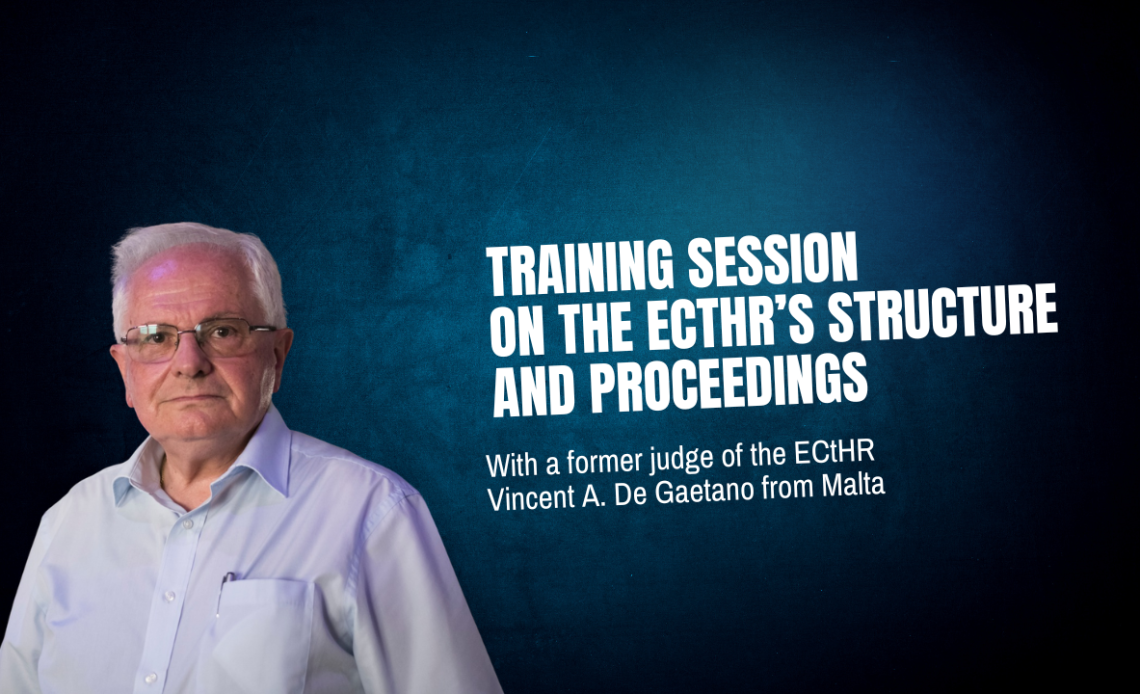
A training session organized for interns and volunteers provided an in-depth exploration of the European Court of Human Rights (ECtHR), delivered by former judge Vincent A. De Gaetano. Drawing on his extensive experience as a judge in Strasbourg and former Chief Justice of Malta, the speaker offered both institutional knowledge and practical insights into how the Court operates in reality.
This report aims to present a comprehensive account of the session, highlighting key legal principles, institutional structures, procedural mechanisms, and contemporary challenges facing the ECtHR.
Historical Background and Purpose of the Court
The European Court of Human Rights was established following the Second World War under the European Convention on Human Rights. Its founding objective was to ensure that the grave human rights violations witnessed during that period would not be repeated. What distinguishes the Convention system is its enforceability. Unlike earlier international frameworks, it created a binding judicial mechanism through which individuals can bring claims against states. This makes the ECtHR a unique supranational court in the global legal order.
A central point emphasized during the session is that the ECtHR is not a court of appeal. It does not reassess domestic court decisions simply because an applicant disagrees with the outcome. Instead, its jurisdiction is limited to determining whether a state has violated rights protected under the Convention.
This distinction is crucial for understanding both the scope and limitations of the Court’s authority. Applicants must, in principle, exhaust all available domestic remedies before applying to Strasbourg. This reflects the principle of subsidiarity, according to which national authorities bear the primary responsibility for protecting human rights.
Institutional Structure and Judicial Formations
The ECtHR operates through several judicial formations, each designed to manage different types of cases efficiently:
- Single Judge: Responsible for filtering out clearly inadmissible applications. This formation handles the majority of cases.
- Committees of Three Judges: Deal with repetitive cases based on well-established case law.
- Chambers of Seven Judges: Examine more complex or novel cases.
- Grand Chamber (17 Judges): Handles the most significant cases, including appeals and matters involving serious interpretation issues.
Additionally, a Grand Chamber Panel acts as a gatekeeping mechanism, deciding whether a case should be referred from a Chamber to the Grand Chamber.
The Role of the Registry
One of the most distinctive aspects of the ECtHR is the central role of its Registry. Unlike domestic courts, where judges are the primary drivers of proceedings, the Registry performs substantial analytical and preparatory work.
Registry lawyers, including non-judicial rapporteurs, assess incoming applications, prepare case files, and assist judges throughout the decision-making process. This structure is essential given the Court’s multilingual environment and the diversity of legal systems across member states.
Judicial Independence and Appointment
Judges of the ECtHR are elected by the Parliamentary Assembly of the Council of Europe from a list of candidates proposed by each state. Although the election process involves political institutions, judges do not represent their countries once appointed.
Judicial independence is maintained through strict ethical standards and the Court’s institutional culture. Judges act in their individual capacity and are bound solely by the Convention.
Case Processing and Well-Established Case Law (WECL)
To handle its large caseload, the Court relies on mechanisms such as “well-established case law” (WECL). This allows repetitive cases—such as those involving prison conditions or excessive delays in judicial proceedings—to be resolved efficiently without full Chamber review. This system ensures consistency while preserving resources for more complex or precedent-setting cases.
Execution of Judgments
Once the Court finds a violation, it may award just satisfaction (financial compensation). However, the more significant impact often lies in the requirement for states to amend laws or administrative practices. Execution of judgments is supervised by the Committee of Ministers of the Council of Europe. While financial compensation is usually implemented promptly, structural reforms can take longer and depend on political will. The enforcement mechanism relies heavily on peer pressure among states rather than direct coercive power.
The principle of subsidiarity ensures that national authorities have the first opportunity to address alleged violations. The Court intervenes only when domestic systems fail to provide effective remedies. Closely linked is the doctrine of the margin of appreciation, which allows states a degree of discretion in how they implement Convention rights, reflecting differences in legal traditions and social contexts. However, this discretion is not unlimited and remains subject to the Court’s supervision.
Practical Insights from Judicial Experience
Judge De Gaetano provided valuable reflections from his tenure, highlighting:
- The cultural and legal diversity within the Court
- The importance of the Registry in maintaining consistency
- The complexity of deliberations and the role of dissenting opinions
- The balance between legal reasoning and institutional pragmatism
You can check the full session on our YouTube channel.