

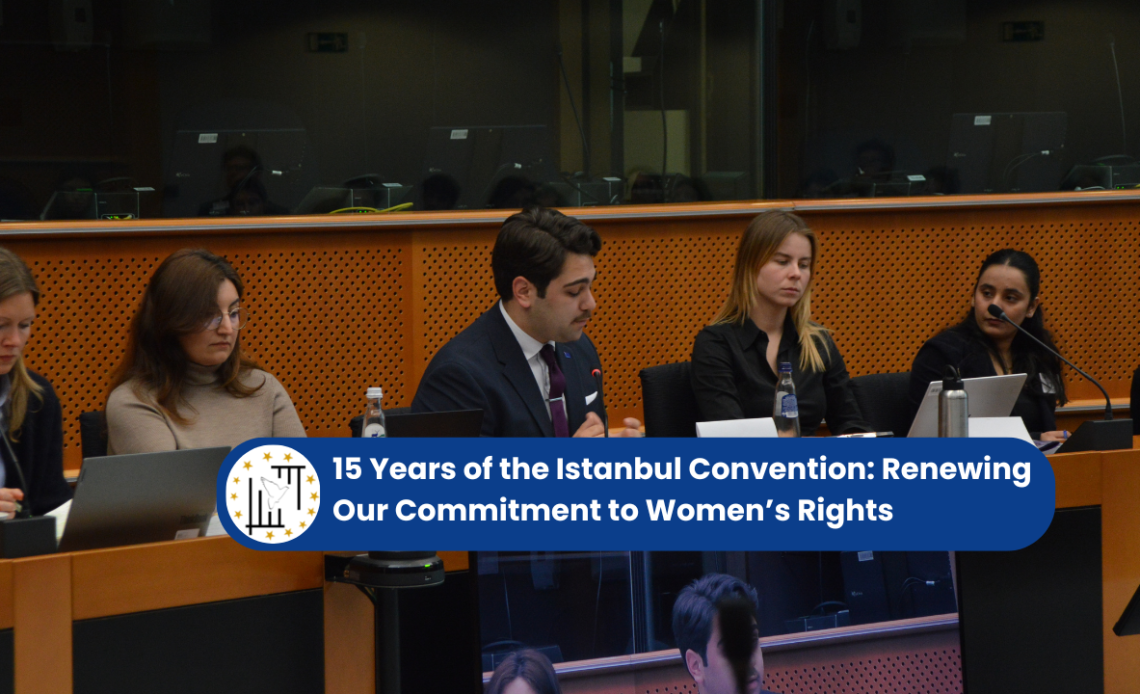
On Monday 13th of April, we had the honour to co-host and moderate the first ASSEDEL event in the European Parliament in Brussels. The panel discussion, titled “15 Years of the Istanbul Convention: Renewing Our Commitment to Women’s Rights”, was organised in collaboration with MEP Anna Strolenberg (Volt, Greens/EFA) and the NGO Solidarity with OTHERS.
On the occasion of the 15th anniversary of the Convention on Preventing and Combating Violence against Women and Domestic Violence, also known as the “Istanbul Convention”, our aim was to delve into the current situation and rising threats to women’s rights in Europe and abroad, to address current challenges in preventing and combating gender-based violence, including social outcry and political positions, and the common stigma that silences victims.
The event brought together experts from diverse backgrounds, offering a comprehensive, multi-perspective approach to the topic. Participants included representatives from the European Commission, the United Nations, the European Parliament, as well as academia and civil society.
Co-hosting the event, MEP Anna Strolenberg opened the discussion by stressing that one of the most effective ways to combat gender-based violence is ensuring full implementation of the Istanbul Convention across all countries. She also pointed to growing concerns over shifting attitudes among younger generations, particularly young men, as a factor that risks undermining progress.
Contribution of Lisa Collste: EU’s accession to the Istanbul Convention and EU Directive on combating violence against women
Lisa Collste, Legal Officer in the Gender Equality Unit of the European Commission (DG JUST), addressed the EU’s implementation of the Istanbul Convention following its accession in 2023. She explained that the EU is bound by the Convention in areas falling under its exclusive competence, such as judicial cooperation in criminal matters, asylum, and aspects of institutional and public administration. In practice, this means that relevant provisions of the Convention are integrated into EU law where the Union already holds internal competence in these fields.
She then referred to the adoption of the 2024 Directive on combating violence against women, which translates key principles of the Istanbul Convention into binding obligations for Member States. The Directive strengthens common standards across the EU, particularly in areas such as prevention, protection of victims, and access to justice. Finally, she underlined that the inclusion of both the Convention and the Directive within the EU legal framework makes them part of the EU acquis, meaning Member States are required to align their national systems accordingly and ensure consistent implementation across the Union.
Dr. Reyhan Kayikci on Turkey’s withdrawal from the Istanbul Convention and concrete examples
During her presentation, Dr. Reyhan Kayikci, Research Fellow at Radboud University, examined the broader social and institutional context of gender-based violence, drawing on concrete examples from Turkey following its withdrawal from the Istanbul Convention in 2021. She noted that this decision was framed in public discourse as a way to protect “traditional values” and families, despite widespread criticism for weakening safeguards for women’s rights.
She further highlighted how certain legal provisions and institutional practices can contribute to the normalisation of violence, including reduced penalties in cases where perpetrators claim provocation. She also discussed the use of emergency mobile applications designed to alert police in situations of domestic violence, stressing both their widespread adoption and their limitations, particularly when responses are delayed or ineffective, which can undermine trust in reporting mechanisms.
Finally, she pointed to persistent structural challenges such as underreporting and insufficient institutional responses, alongside worrying trends in social attitudes, including the growing acceptance of violence among younger generations, underlining the need to address both legal frameworks and enforcement practices in a comprehensive way.
Reem Alsalem on persistent gaps in protection and the need for stronger implementation of the Istanbul Convention
The contribution of Reem Alsalem, UN Special Rapporteur on violence against women and girls, its causes and consequences, consisted in a pre-recorded video message that was presented during the event. She underlined that significant challenges persist across the EU in addressing violence against women, particularly affecting groups such as refugees and undocumented women, who often face barriers to access rights and to reporting abuse, and are therefore underrepresented in official data.
She stressed the need for sustained investment in prevention and support initiatives, warning that structural inequalities continue to limit protection for the most vulnerable. While acknowledging the importance of the Istanbul Convention as a key international framework, she cautioned that its implementation is often deprioritised and underfunded, and called for stronger political and financial commitment to ensure its effective application.
Besides an active participation from the audience, we were also honoured by the presence of MEP Marc Angel (S&D), who participated in the discussion, sharing his insights on women’s rights and gender-based violence within the European Union.
In conclusion, ASSEDEL has prepared an open letter addressed to the Council of Europe, reaffirming the importance of the Istanbul Convention as a concrete follow-up to the event, that calls for:
- Strengthened political leadership to safeguard the Istanbul Convention,
- Swift ratification and full implementation across all EU Member States,
- Renewed dialogue with countries that have withdrawn, to encourage re-engagement.
You can read the text of the open letter here.