

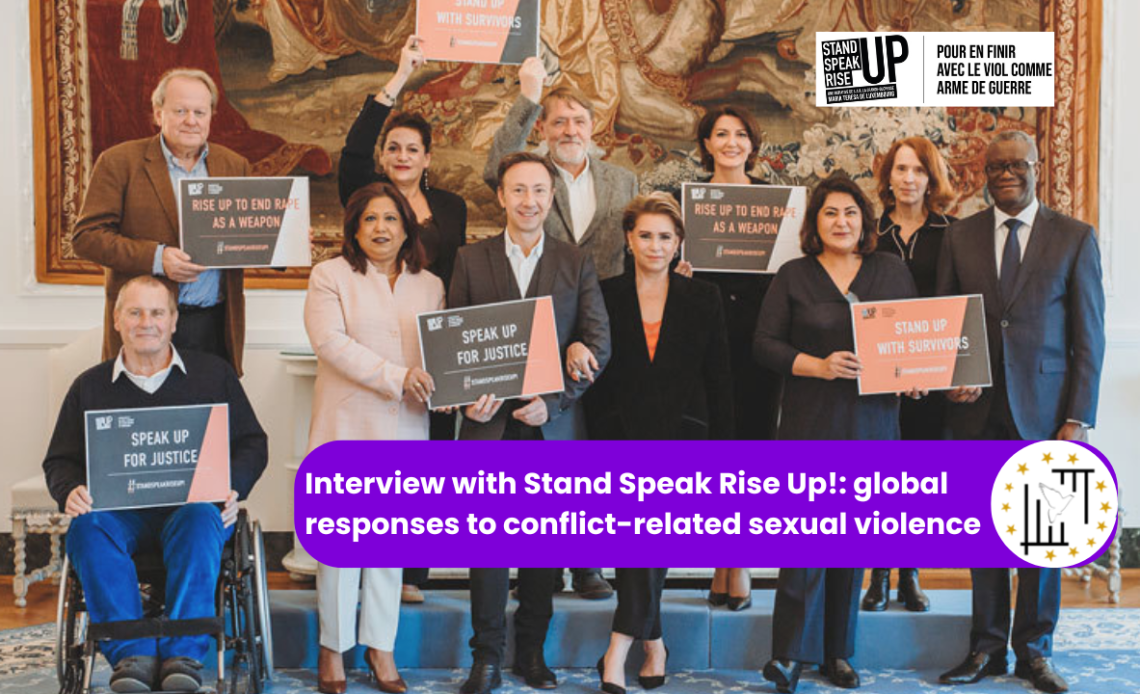
Since its creation in 2019 by HRH Grand Duchess Maria Teresa of Luxembourg, Chékéba Hachemi, now surrounded by renowned international figures including Dr Mukwege, Pramila Patten, Prof. Yunus, Céline Bardet, among others, Stand Speak Rise Up! supports survivors of sexual violence in fragile areas and children born of rape, through projects in the field but also through advocacy actions carried out by the Board of Directors. The association thus funds holistic projects around the world aimed at the reconstruction and socio-economic integration of survivors and children born of rape.
In conflicts, women’s bodies become part of the battlefield, sexual assaults become an active way to damage the enemy, disrupting social ties and invading the most private sphere of people’s lives. This is of course rooted in the patriarchal conception that women are men’s property, we therefore think it is important to prevent and act at the source through education and awareness, to produce a long term social change. How do you think institutions around the world should approach the topic?
Institutions around the world should first ensure the effective implementation of UN standards. Although many human rights treaties and UN resolutions condemn sexual violence as a weapon of war, these commitments are not always fully applied in national legal and institutional systems. Training for civil servants, as well as military and security personnel, is also essential. Such training helps ensure that sexual violence is understood not as an inevitable consequence of war, but as a deliberate tactic of domination that must be prevented and punished.
Institutions should of course concentrate on education from early schooling onward and challenge patriarchal norms and dismantles the idea that women’s bodies are commodities. This is why the staff of Stand Speak Rise Up! intervene regularly in schools, we are also developing a network of young ambassadors to raise awareness among youth and to build a generation committed to justice and equality.
Being ASSEDEL a civil society organization we are first and foremost wondering what are some concrete actions that civil societies can take other than raise awareness to prevent and respond to conflict related sexual violence?
Civil society organizations play a decisive role that goes far beyond awareness-raising. They can contribute concretely by investing in prevention, in particular through education programmes that engage boys and men around positive masculinities, gender equality, and non-violent norms. Changing social attitudes at community level is essential to tackling the root causes of conflict-related sexual violence and to preventing its recurrence.
Civil society can also mobilize financial resources and partnerships to support survivor-centred initiatives. This includes funding access to medical and psychosocial care, legal assistance, education, and livelihood opportunities that enable survivors to rebuild their lives with dignity. Supporting local and survivor-led organizations is particularly crucial, as they are often the first responders and best positioned to provide culturally adapted and trusted support.
In addition, civil society has a strong role to play in advocacy and accountability. By engaging political leaders and institutions, organizations can push for stronger prevention policies, better protection mechanisms, and concrete action against impunity. They can also contribute to documenting violations and supporting pathways to justice, ensuring that survivors’ voices are heard and that crimes are recognized and prosecuted.
Finally, civil society helps build protection at community level by creating safe spaces, strengthening referral networks, and fostering solidarity around survivors. Acting as a bridge between communities, institutions, and international actors, it ensures that responses remain grounded in real needs and that survivors are supported in a comprehensive and sustainable way.
Having to cope with sexual violence is already difficult in normal day life, we can only imagine how it must be in a conflict enviroment where you don’t have security and access to physical and psychological support is often hindered, what are some actions that institutions that work on the field can take to support survivors?
Institutions operating in conflict settings must adopt survivor-centred and trauma-informed approaches that reflect the extreme insecurity and vulnerability survivors face. Immediate and safe access to medical care is essential, including sexual and reproductive health services, emergency treatment, and long-term follow-up. Psychosocial support must also be made accessible through mobile teams, community-based services, and culturally adapted mental health care, especially where infrastructure is weakened or destroyed.
A particularly powerful framework is the holistic model developed by Dr. Denis Mukwege Nobel Peace prize laureate and administrator of Stand Speak Rise Up!, which is based on four pillars: medical care, psychosocial support, legal assistance, and socio-economic reintegration. This integrated approach recognizes that healing is not only physical, but also psychological, social, and economic. It ensures that survivors are supported comprehensively, rather than through fragmented interventions.
Protection and confidentiality are equally critical. Survivors must be able to seek help without fear of retaliation, stigma, or exclusion. Strong coordination between health, legal, protection, and humanitarian actors is therefore essential to create secure referral pathways and ensure continuity of care.
At Stand Speak Rise Up!, we are deeply inspired by this holistic vision. Supporting survivors means not only responding to immediate needs, but also investing in their long-term autonomy through education, vocational training, and economic empowerment. Survivors should not be viewed solely as beneficiaries of assistance, but as partners and agents of change, whose resilience and leadership are central to sustainable recovery and prevention.
How is it possible to reach soldiers when authorities incentivize or express a tacit consent to the use of sexual violence as a weapon against the enemy?
Reaching soldiers in contexts where sexual violence is tolerated or even encouraged by authorities is extremely challenging, but not impossible. One important entry point is through training and engagement within military and security structures themselves, including integrating international humanitarian law into military education, working with commanders on codes of conduct, and supporting internal accountability mechanisms. Even in difficult political environments, there are often individuals and units willing to engage on issues related to protection of civilians and professional ethics. Strengthening their capacity and responsibility can help establish internal norms that reject the use of sexual violence.
Another key approach is to reinforce accountability frameworks. When documentation of crimes is carried out and legal consequences become credible, whether at national or international level, it sends a strong signal within armed groups that such acts are not without consequence (through independent investigations, preservation of evidence, and cooperation with international mechanisms such as the International Criminal Court when national systems fail). This contributes to deterrence and can influence behaviour over time.
Engagement can also happen indirectly through community-based approaches and reintegration programmes. Former combatants, veterans, and peer networks can play an important role in shifting norms from within, particularly when discussions address masculinity, trauma, power, and responsibility, for example through psychosocial support, dialogue initiatives, and leadership programmes promoting non-violent masculinities and respect for civilians.
Finally, sustained advocacy at international level remains essential. Civil society and institutions must continue to pressure political and military leaders to uphold their obligations under international law, protect civilians, and condemn the use of sexual violence unequivocally including diplomatic pressure, sanctions, conditional funding, and public reporting. Even where tacit consent exists, consistent international engagement can gradually change incentives and open space for prevention efforts within armed forces, while supporting local actors and survivor-led organizations working on documentation and protection.
What long-term impacts do children born of conflict-related sexual violence experience within their families and communities? How does your organization address the specific needs and rights of children born as a result of rape in conflict settings?
The specific harms faced by children conceived through CRSV have only recently been recognized as a human rights concern. It is estimated that tens of thousands of children have been born from sexual violence or exploitation in conflict over the past decades. From birth, many of these children grow up carrying the social consequences of the violence surrounding their conception. Because they are sometimes associated with the “enemy,” they may face rejection, stigma, and discrimination within families and communities.
The impacts can be long-lasting. Many experience psychological distress, social exclusion, bullying, or isolation. In some cases, children have been abandoned or, in extreme situations, exposed to violence during infancy. Economic hardship also increases their vulnerability to food insecurity, limited education, and lack of healthcare. Some may also face risks such as exploitation, trafficking, or recruitment into armed groups.
As they grow older, legal barriers may also appear. In some countries, children born of wartime rape may face difficulties obtaining citizenship, especially where nationality is based on bloodline or when the father is unknown, absent, or considered an enemy. Without legal identity, access to education, healthcare, and employment becomes harder, and freedom of movement can be restricted.
Since 2019, Stand Speak Rise Up! has been working toward the legal recognition and social inclusion of children born of CRSV. Significant progress was made in 2022 in Bosnia and Herzegovina, where these children were recognized as civilian victims of war, making them eligible for compensation. In 2024, the association strengthened its advocacy and awareness-raising efforts through film screenings and documentaries, including Hawar, Our Banished Children, and The Wound Is Where the Light Enters. The organization also developed partnerships to amplify these children’s voices and defend their fundamental rights.
In addition, Stand Speak Rise Up! supports concrete education projects for children born of rape in conflict settings, notably in Uganda and in the Democratic Republic of the Congo. These initiatives aim to ensure access to schooling, cover school fees and materials, and provide psychosocial support when needed. By investing in education, the organization seeks to break cycles of exclusion and vulnerability, restore dignity, and create real prospects for social inclusion and autonomy. Through these combined legal, advocacy, and field-based actions, Stand Speak Rise Up! works to ensure that these children are recognized not as symbols of violence, but as rights-holders with full potential and a future.
What responsibilities do media and international actors have when amplifying survivor voices? How can visibility and advocacy efforts balance awareness-raising with privacy and protection?
Media and international actors have a major responsibility when amplifying survivors’ voices. They must ensure that interviews are conducted with care, with clear informed consent, and with strict respect for privacy, safety, and survivors’ boundaries. Survivors should never feel pressured to share details and must be able to remain anonymous or withdraw at any time. Avoiding sensationalism is essential to prevent retraumatization and further harm.
Beyond this, media must act as responsible amplifiers and advocates. Their role is not only to tell individual stories, but to denounce crimes, highlight patterns of violence, and carry the voices of those who speak out. By giving visibility to survivors’ demands and exposing structural responsibilities, they can help shift public attention from individual suffering to accountability and prevention. International actors also have a duty to ensure that visibility leads to action, through policy change, support to survivor-led initiatives, and sustained engagement. Raising awareness should ultimately serve protection, justice, and long-term support, not exposure for its own sake.
How can organizations ensure survivors are meaningfully involved in designing programs and advocacy strategies? Can communities be the central organ to create survivors-led support networks?
Survivors should be involved from the very beginning, identifying priorities, shaping programs and helping to define success indicators. At the same time, participation must always be voluntary. No survivor should ever feel pressured to share their story publicly in order to receive support. That’s why we place survivors at the center of our actions. Rather than speaking for survivors, Stand Speak Rise Up! creates spaces where survivors can lead, participate in decision-making, and transform their experiences into collective strength and social change.
Communities can and should be at the center of survivor-led networks, provided that safeguards and resources are in place ! Community-based networks are powerful because they reduce isolation and stigma, build peer solidarity and mutual support, ensure responses are culturally relevant and create sustainable local ownership beyond short-term projects. However, these community-led initiatives need to be properly funded and connected to broader institutional frameworks. Without financial support, legal backing, and security measures, survivor leaders may face backlash or renewed harm.
What projects promoted by Stand Speak Rise Up! have been proved to be more effective to have a long term empowerment of the survivors?
There is no single project that is more effective than another when it comes to long-term empowerment. At Stand Speak Rise Up!, we believe that sustainable recovery can only be achieved through a holistic approach that addresses all dimensions of survivors’ lives simultaneously: economic independence, health, education, housing, legal recognition, and social inclusion.
For example, in the eastern Democratic Republic of the Congo, particularly in the Kivus, we support vocational training and income-generating activities for survivors of conflict-related sexual violence. Women receive practical training adapted to the local context, such as agriculture, small trade, or other revenue-generating skills, alongside start-up support to launch their own activities. We also support the construction and rehabilitation of homes to ensure that survivors and their children can live in safe, stable, and dignified conditions, which is essential for sustainable recovery and reintegration. Crucially, these programmes are combined with psychosocial support, recognizing that economic recovery alone is not sufficient without addressing trauma and rebuilding self-confidence.
Similarly, in contexts such as Somalia or Tigray, we support initiatives that link livelihood opportunities with psychological accompaniment. This dual approach helps survivors regain autonomy, restore dignity, and strengthen their resilience within their communities. These examples illustrate our conviction: long-term empowerment does not come from one isolated intervention, but from integrated programmes that address various dimensions of recovery, enabling survivors to rebuild their lives in a sustainable way.
In 2025, we launched a mentoring programme for survivors of sexual violence and children born of rape to strengthen self-confidence and support personal recovery. Through training and individualized guidance provided by volunteer mentors, participants gain concrete skills that foster autonomy, leadership, and the ability to share their experiences with dignity. Beyond mentorship, the programme creates a space of solidarity and co-creation, encouraging mutual support and collective resilience within their communities.
Do you think the concept of rape as a weapon of war is sufficiently addressed in international law frameworks? What gaps exist between legal recognition and enforcement? How can these gaps be closed to improve accountability and survivor support?
Many NGOs and experts agree that the use of rape as a weapon of war is now sufficiently addressed in international law. Sexual violence in conflict is recognized as a serious international crime, including war crimes and crimes against humanity. Frameworks such as the International Criminal Court and the Rome Statute of the International Criminal Court establish that sexual violence in war is prohibited and punishable under international law.
However, legal recognition does not always translate into effective enforcement. In many contexts, survivors still face major obstacles in accessing justice, including weak witness protection systems and insufficient reparations mechanisms. For these reasons, stronger implementation of existing laws is essential. Legal norms are only meaningful when they are supported by concrete action, accountability mechanisms, and full respect for survivors’ rights to justice, protection, and reparation.