

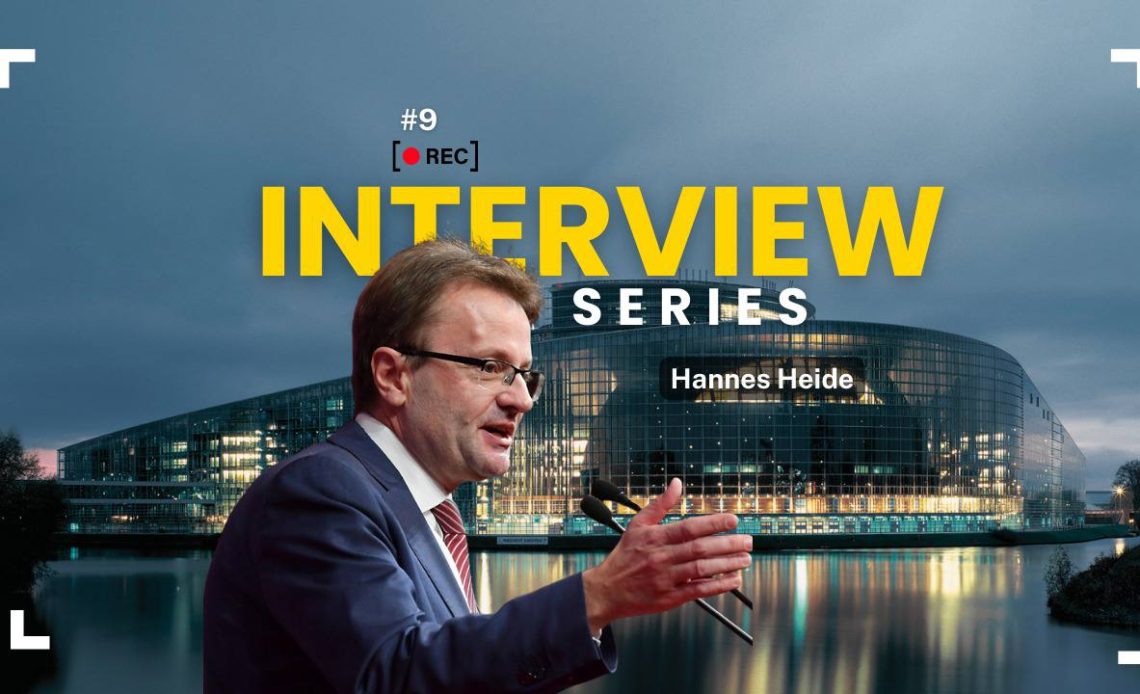
We had the pleasure of meeting with Hannes Heide, Member of the European Parliament (MEP) and member of the Committee on Culture and Education (CULT). During the conversation, Mr. Heide shared his perspectives on the committee’s priorities, the importance of cultural and educational programs such as Erasmus+, and the evolving challenges facing Europe’s creative and academic sectors.
Key Priorities of the CULT Committee
Mr. Heide emphasized that the European Union is currently facing both external and internal challenges, making it crucial for the CULT Committee to strengthen its efforts in promoting education, culture, and civic engagement. One of the committee’s main priorities is the Multiannual Financial Framework (MFF), which defines the EU’s long-term budget. From the CULT perspective, the MFF directly affects how citizens particularly young Europeans connect with the European Union through initiatives such as Erasmus+ and Creative Europe. “Erasmus+ is a flagship program connecting young people with the European Union. We must ensure that more young Europeans are able to participate in the coming years,” said Mr. Heide.
He also underlined the significance of supporting citizen engagement and the creative industries, which continue to grow despite economic challenges. For example, Europe’s music industry expanded by 9% last year, a sign of the sector’s resilience and cultural impact.
“It’s important to raise awareness among citizens about how vital the creative sector is not only economically, but also for shaping our shared European identity,” he added.
Erasmus+: A Success Story for All Europeans
Erasmus+ remains at the heart of Mr. Heide’s vision for a more inclusive and connected Europe. He described it as one of the EU’s most successful programs and called for expanding both its budget and accessibility.
“Everyone in Europe should have the opportunity to take part in an Erasmus+ project, regardless of background, financial means, or age,” he said. “Participation can still be expensive, and not everyone has equal access. We must open the program to all sectors including sports, people with disabilities, and intergenerational groups.”
Mr. Heide stressed that Erasmus+ must continue to evolve to meet the needs of a changing Europe.
“The program can never stand still, it has to remain dynamic and open to everyone.”
Promoting Academic Freedom and Respecting the Rule of Law
Addressing recent discussions on governance in higher education, Mr. Heide noted that compliance with European values and rules is essential for participation in EU-funded programs.
“Erasmus+ can only be successful if we have clear rules and all participants follow them. The issue is not about excluding countries, but about ensuring transparency, good governance, and respect for academic freedom.”
Tackling Foreign Influence in Education and Research
Mr. Heide also spoke about growing concerns over foreign influence in European education and research, particularly regarding funding from China.
“There is now much more awareness of what external influence can mean,” he said. “Many institutions have become more cautious, and cooperation is approached more carefully than before.”
He emphasized that maintaining academic independence requires vigilance at both EU and national levels, highlighting that cultural and educational sectors are also vulnerable to geopolitical pressures.
Enhancing Europe’s Academic Competitiveness
When asked about Europe’s position in global university rankings, Mr. Heide recognized progress but pointed to ongoing challenges such as brain drain to countries like the United States.
“Many leading European scientists and professors have moved abroad for better conditions. However, this also presents an opportunity, Europe can attract back its talent by creating supportive environments for research and innovation.”
He reiterated that universities play a crucial role in Europe’s global competitiveness and are central to strengthening democracy and innovation.
Artificial Intelligence and the Creative Sector
The use of artificial intelligence (AI) in the creative industries is another key focus for the CULT Committee. Mr. Heide highlighted both the opportunities and ethical challenges that come with new technologies.
“AI can be a helpful tool, but we must ensure that creators are recognized and fairly compensated when their work is used to train AI systems,” he explained.
He cited the example of historians and authors whose works have been used without consent, stressing the importance of updating legal frameworks to protect intellectual property and Europe’s cultural heritage.
Looking Ahead: Education as the Foundation of Democracy
When asked about one measure he would prioritize in this parliamentary term to strengthen education and academic freedom, Mr. Heide returned to the program he sees as the EU’s greatest success story:
“Erasmus+. With a relatively small budget, it has achieved remarkable results. Imagine what we could do with four times the current funding.”
He concluded by reaffirming that education and culture are the foundations of Europe’s democracy and unity.
“We don’t talk enough about these topics,” he said. “Culture and education are what keep Europe united.”
Watch the full interview on our YouTube channel!
