

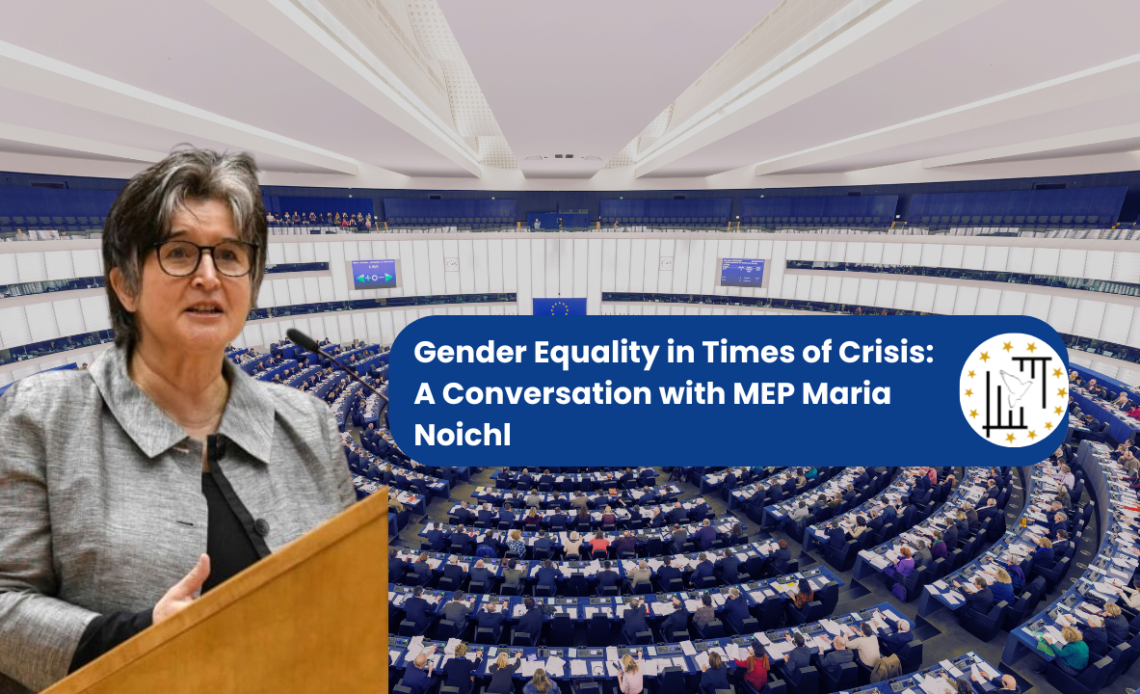
During the plenary sessions of March in Strasbourg, in the context of the women’s international day, ASSEDEL conducted several works about current concerns that affect women around the world and the feminist cause. Several reports were uploaded in our website about different topics such as: The European Union and the loss of its moral and geopolitical authority: A conversation with the MEP Rudi Kennes and The EU-Mercosur Agreement and its balance with human rights: A Conversation with MEP Oihane Agirregoitia.
Concerning the European Parliament’s role in this project, several Members of the European Parliament (MEPs) were contacted and invited to collaborate in an interview discussing key topics from our website. Some accepted in-person interviews in the parliament, such as Anna Strolenberg and Alessandra Moretti. In other cases when a recorded interview was not possible, collaboration continued through written feedback and exchanges.
Regarding this article, a MEP from Germany, Maria Noichl, agreed to participate by answering some concerns that are affecting women’s liberties worldwide. Ms. Noichl is a member of the Committee of Women Rights and Gender Equality (FEMM) in representation of the Group of the Progressive Alliance of Socialist and Democrats (S&D). As such, she is committed to combating all forms of discrimination and defending fundamental rights for all (Socialists and Democrats, 2026). Her experience on the committee makes her a valuable source for understanding a feminist perspective on these issues.
Economic resources for health assistance
The first question was about the economic assistance for health issues that affect women, especially when it comes to death-risks relating to abortions. Article 9 of the TFEU (Treaty on Functioning of the European Union) states that the Union must take into account the protection of human health in all its policies, and Article 168 allows for incentive measures to improve health. Furthermore,“My Voice, My Choice” is a European Citizens’ Initiative (ECI) advocating for safe and accessible abortion care across the EU, which has gathered over one million signatures across Europe.
Given this, we posed the question: Why did the Commission opt for a voluntary funding clarification through the European Social Fund + (ESF+) rather than proposing a new, binding legislative instrument under the health powers provided by Article 9?
In response, Ms Noichl highlighted the importance of getting proposals backed by all Member States. That is the reason behind the Commission’s decision, even though they are concerned about the topic’s implications with the fundamental women rights. Nonetheless, this fund demonstrates the effectiveness of economic assistance that the EU can provide to help women access safe and legal abortion care, despite the absence of a separate budget. Noichl assured that she and her colleagues will continue to work on the Multiannual Financial Framework (MFF) and promote the demands coming from citizenship initiatives.
Persisting in the Istanbul Convention principles at national level
Our following question refers to a legal-political decision with an international scope. Based on Turkiye’s recent withdrawn from the Istanbul Convention, namely the Convention on Preventing and Combating Violence against Women and Domestic Violence, as well as the failure of several member states, such as Lithuania, Bulgaria, Hungary, Czechia and Slovakia to ratify it, we sought to know how the EU should act in regards to the conservative movement across the continent.
Ms Noichl understands the importance of making gender-based violence an EU-crime according to article 83(1) TFEU. She additionally argues how other crimes need to be combatted on a common basis such as human, drugs, and arms trafficking, computer crime and terrorism. The EU is able to enforce demands and the principles enshrined in the Istanbul Convention through its own legislation leading to the same standard of protection, prevention and prosecution from gender-based violence across the EU.
Horizontal legal-definition of concepts within the EU
One of the concerns that came up in reference to implementations of principles within national legal systems, was to make sure that a common framework should exist in the definition of crimes. This would shield the judicial protection across member states and better protect the victims of rape abuse.
Therefore, we asked the following questions: How would the introduction of an EU-level definition of consent-based rape impact national legal systems and victim protection? What challenges might arise in its adoption and implementation?
In response, Ms Noichl highlighted the persistent work that the FEMM committee is doing to achieve a common definition. She affirms, “We already tried this during the negotiations on the directive on combating violence against women and domestic violence.” However, she commented on the difficulties that involve gaining a recognizable majority as she mentions “Due to the fear of lacking a legal basis, this topic was eventually not included in the directive. But once achieved, which would as well be possible if gender-based violence was recognised as an EU-crime, it would lead to the same protection of women from rape across the EU and especially help changing mentalities and minds with regards to consent.”
Rejection of modern technological instruments as tools to commit violence
Artificial intelligence and social media are modern tools that are increasingly a part of our daily lives and they open the door to a wide range of ways to spread messages and content. However, this development brings several risks that particularly affect women, harming their reputations through the spread of false intimate content that violates the dignity and privacy of victims. As a feminist she condemns apps such as Grok, which shape explicit content, targeting mostly women and girls and constituting a form of gender-based violence. She stresses that any backsliding of rights in the digital space is unacceptable.
Feminism must endure alongside other challenges
In the conclusion of the interview, we asked Ms Noichl what she considers to be the next frontier of gender-sensitive policymaking at the European level. She reminded that the “biggest challenge is not to forget gender equality and women’s rights in a moment of multiple crises, like war and the attacks of the extreme right. We cannot afford to take any steps backwards, and therefore we must fight twice as hard.” This is an important reminder and reflection about feminism, which is not a thematic policy issue to discuss, but a human right cause, and a duty that human beings need to comprehend. To deal with a crisis, we must take a feminist approach, a perspective that takes women into consideration as well as their concerns.